
The cornerstone of success and sustainability in agricultural production is the correct management of water. It is not just about giving water, but delivering the amount the plant needs to the root zone at the right time and in a controlled manner, which requires a professional approach. As Esular, by combining our expertise in agricultural technologies with academic data, we have prepared a comprehensive irrigation guide for our farmers and agricultural professionals. In this guide, you will find every detail from soil structure to plant water consumption, from critical calculation formulas to modern automation solutions.
1. Basics of Agricultural Irrigation and Turkey's Current Situation
Irrigation is the controlled application of water, which is necessary for the normal development of the plant but cannot be met by natural precipitation, to the soil in the plant root zone at the required time and amount. Approximately 28 million hectares of Turkey's 78 million hectares of total area are agricultural land, and 25 million hectares are in the status of irrigable land. However, current data shows that there is a serious need for modernization in the irrigation methods applied.
- Surface Irrigation: 85% (Also known as wild irrigation, water loss is high)
- Sprinkler Irrigation: 12%
- Drip Irrigation: 3% (Although it is the most efficient method, its usage rate is low)
The fact that wild irrigation is so high brings along serious environmental problems such as erosion, rising water tables, and the salinization and desertification of soils. At this point, smart irrigation systems and sensor technologies play a critical role in turning every drop of water into yield.
2. Soil-Water-Plant Relationship: Invisible Engineering
In irrigation project design, the physical properties of the soil are the most important factor determining the capacity of the system. Soil consists of three phases: solid (particles), liquid (water), and gas (air). In an ideal irrigation, the balance of air and water in the soil pores should be kept at a ratio where the plant can breathe and draw water easily.
Soil Texture and Infiltration Rate
The speed at which water enters the soil, called infiltration (water intake rate), is decisive in the choice of irrigation method. According to soil texture, water intake rates (mm/h) are as follows:
- Sand: 25.0 - 250.0 mm/h (Very fast, requires frequent and small amounts of irrigation)
- Loam: 8.0 - 20.0 mm/h (Ideal agricultural soil)
- Clay: 0.1 - 5.0 mm/h (Very slow, high risk of water ponding on the surface)
If your irrigation rate is higher than the soil's water intake rate, the water flows off the surface instead of entering the soil and causes erosion. This situation reveals the importance of drip irrigation and precision flow valve control systems, especially on sloping lands.
3. Critical Irrigation Concepts: Field Capacity and Wilting Point
The two most important terms a farmer should know are Field Capacity and Wilting Point. Field capacity is the maximum amount of water the soil can hold against gravity. The wilting point is the critical threshold where the plant cannot take water from the soil and begins to dry out permanently. The difference between these two values is called Available Water Holding Capacity, and the plant can only benefit from the water in this range.
Plant Effective Root Depth
When irrigating, it is essential to wet the Effective Root Depth, where the plant meets 80% of its water and nutrient needs, not the entire soil profile. For some plants, these depths are as follows:
- Cotton, Maize, Wheat, Alfalfa: 90 cm
- Fruit Trees and Citrus: 120 cm
- Tomato, Pepper, Eggplant: 60-90 cm
- Strawberry, Lettuce, Onion: 45-60 cm
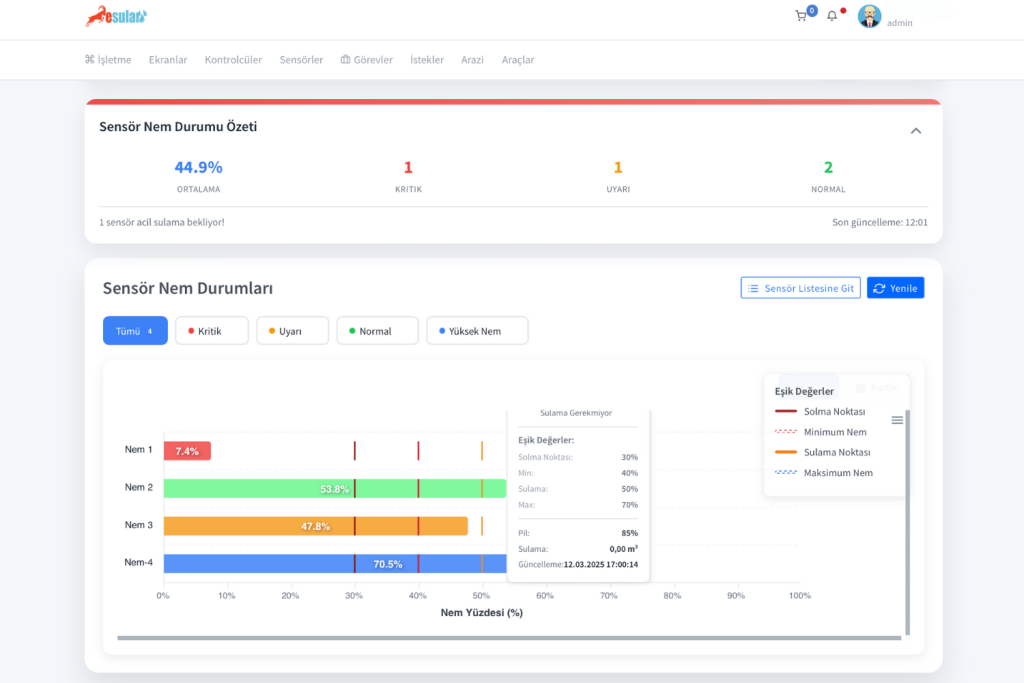
Esular soil moisture sensors prevent water from seeping deeper and being wasted or the root zone from remaining dehydrated by monitoring the moisture changes in exactly these root zones instantaneously.
4. Plant Water Consumption (Evapotranspiration - ET)
Plant water consumption is the sum of evaporation from the soil surface and transpiration from the plant leaves. Factors affecting the ET value are:
- Climate: As temperature, wind speed, and solar radiation increase, ET increases; as relative humidity increases, ET decreases.
- Plant Type: Each plant's water requirement is different.
- Development Stage: Plants are much more sensitive to water, especially during certain periods.
Periods When Plants Are Most Sensitive to Water
In order not to experience yield loss, irrigation should never be neglected during these periods:
- Cereals: Stem elongation and heading period
- Maize: Tasseling period
- Cotton: The period from flowering to boll opening
- Potatoes: Flowering and tuber formation
- Fruit Trees: Throughout the fruit development period
5. Professional Irrigation Calculations
For engineering-based irrigation management, the following basic formulas should be used. These calculations ensure the correct determination of system capacity (pump, pipe diameter, etc.).
Net Irrigation Water Amount (dn)
It expresses the net amount of water that should be given in each irrigation. It is calculated with the following formula based on soil moisture measurements:dn = (TK - SN) x Ry x γt x D / 100Here, Ry represents the moisture level at which irrigation will start (usually 50%), and D represents the root depth.
Irrigation Interval (SA)
The number of days passing between two irrigations:SA = dn / ETIf the daily water consumption (ET) is 7 mm and your net irrigation amount (dn) is 70 mm, your irrigation interval is 10 days.
System Capacity (Q)
The flow rate in liters per second (L/s) required to irrigate the entire land:Q = (A x dt) / (3.6 x T)In this formula, A is the area, dt is the total irrigation water, and T is the daily operating time.
6. Conclusion: Manage the Future with Smart Irrigation
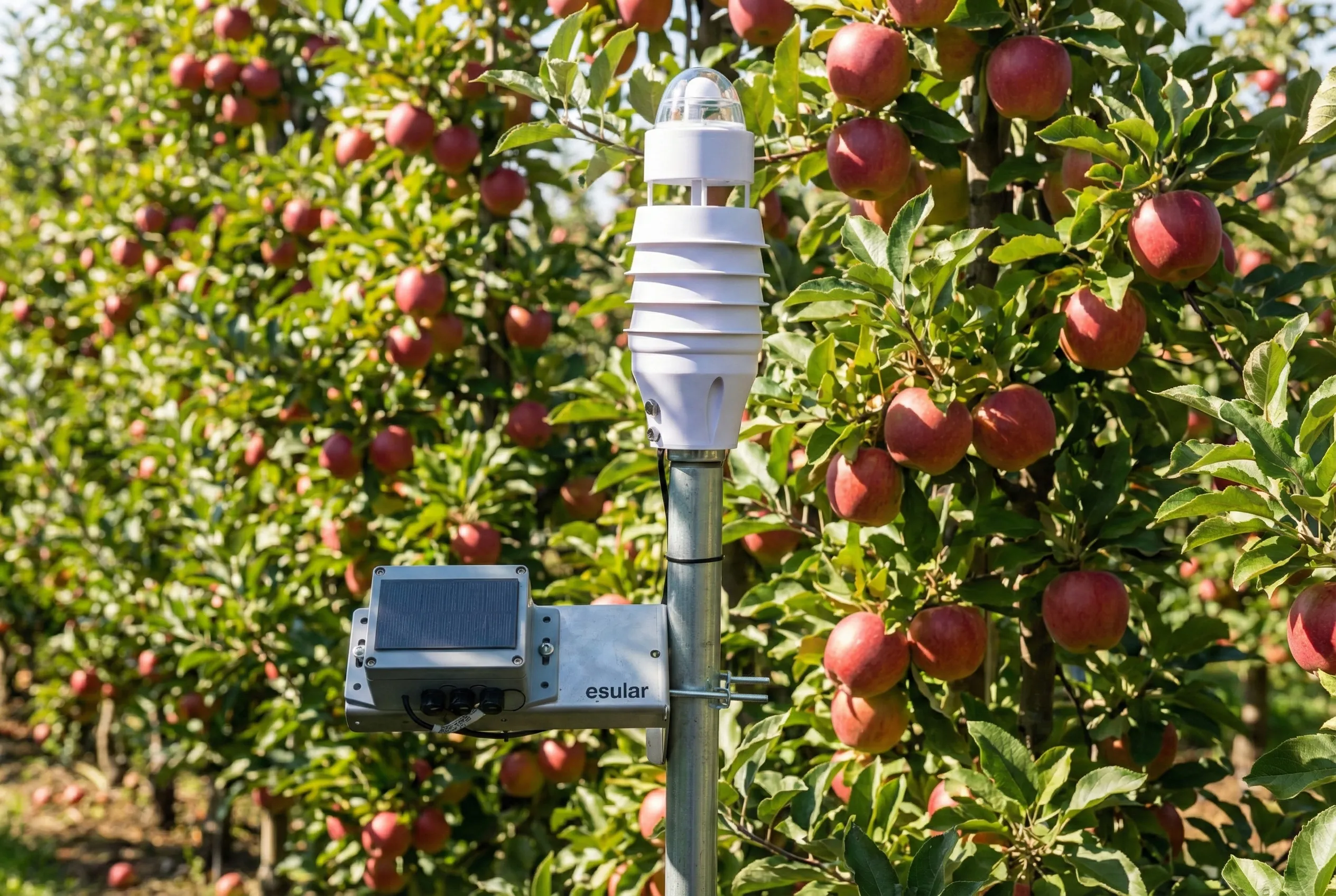
In irrigation carried out with traditional methods, either the soil is salinized by giving excessive water or the yield potential is not reached with insufficient irrigation. Esular Smart Irrigation Systems perform these complex calculations and tracking for you. With our wireless valve control units, weather stations, and precision soil moisture sensors; we deliver only as much water as the plant needs to the root zone exactly on time.
If you also want to increase yield by up to 30% in your field and save 50% on water and energy costs, meet Esular's IoT-based modern agricultural solutions. Remember, correct irrigation is not just a technique, but the greatest investment made in your soil and your future.