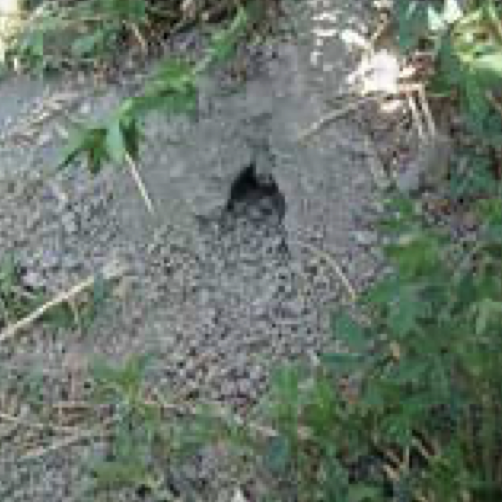
Field mice are a pest that significantly endangers yield and quality in agricultural production across the country.
What is a Field Mouse?
The field mouse mostly has a short and stocky body structure. Their heads are quite large, their noses are flat, and their ears have a short appearance. Their tails are short in proportion to their bodies and are generally about one-fifth of the body length. The back fur has dark gray tones at the base and brown-red tones at the top. The abdominal area is white or off-white. Body length ranges between 90-180 mm, tail length 18-53 mm, hind foot length 19-24 mm, and body weight is 30-60 g. They can be found in many different environments where plants grow, up to altitudes of 2500 meters above sea level. Field mice live underground at depths of 10-70 cm and in galleries with 4 to 12 entrance holes. They usually carry out their activities during the night. Although females have the capacity to give birth every month, they give birth 4 to 6 times a year. They can give birth to a maximum of 9 offspring in each birth, but they generally give an average of 5 to 6 offspring.Their gestation period is 3 weeks. Approximately 40% of the born offspring cannot survive for various reasons. The offspring, which are weaned 15-20 days after birth, start feeding on their own and become harmful from this point onwards. They reach maturity within 2-3 months and live for an average of 3-4 years.
Field Mouse Holes
Field mice open three different types of holes in the area where they live:
Feeding holes,
Excavation (soil removal) holes,
Defecation holes.
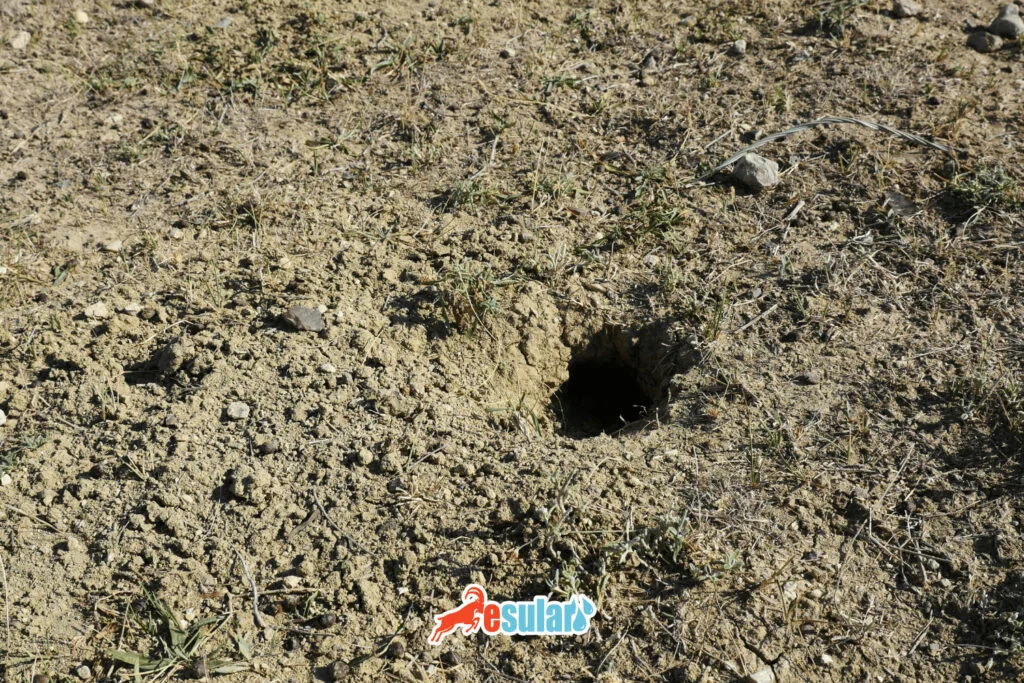
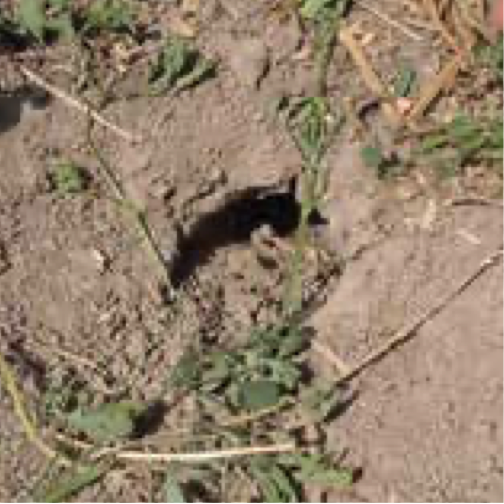
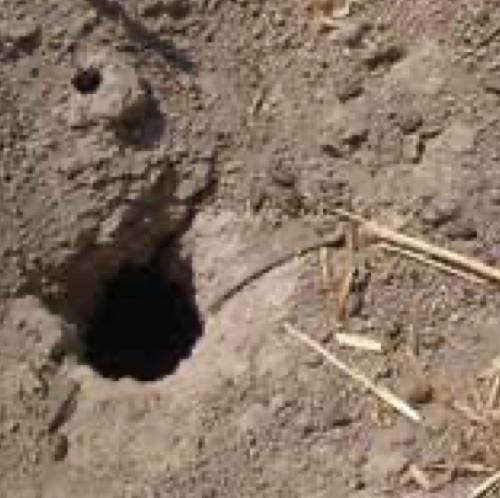
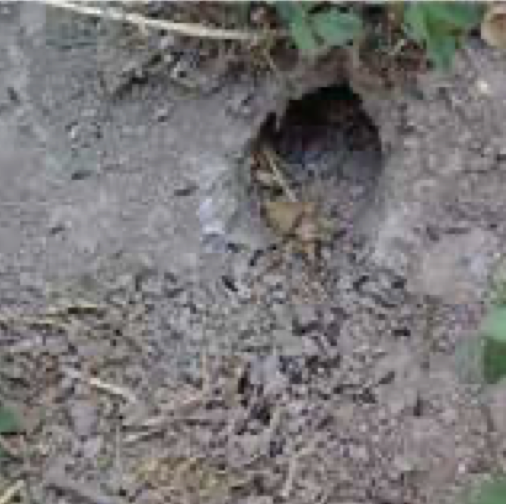
We can easily identify these holes because excavation holes contain soil mounds, defecation holes contain mouse droppings, and feeding holes contain food residues. Correct identification of these holes is important during chemical control because mice do not consume the poisoned bait left in holes other than feeding holes.
Field mouse feeding hole
Field mouse vertical feeding hole
Field mouse defecation hole
Field mouse excavation hole
Plants It Damages and Damage Type
Field mice are among the pests that cause significant damage usually to field, garden, and meadow-pasture plants such as wheat, barley, oats, corn, clover, vegetables, and fruits. Furthermore, especially young forest trees are the primary hosts of these mice. They cause damage by consuming, contaminating, and gnawing the green parts, seeds, and fruits of cultivated plants and meadow-pasture plants. In cases where they cannot find food, they cause damage by gnawing the trunks (especially the root collar) of saplings in orchards and forests. When food sources in a region are exhausted, mice spread to other areas and continue their damage. They generally prefer green feed in warm months and dry feed in cool months. An adult field mouse can consume an average of 15-17 grams of green feed and 10-13 grams of dry feed per day. The amount of damage can rise up to 100% in direct proportion to the loss rate.
How Does the Field Mouse Disappear? Its Control
Natural Control:
The main natural enemies of field mice include cats, dogs, foxes, weasels, martens, owls, storks, kestrels, hawks, falcons, eagles, and snakes. In environments where natural balance is maintained, these natural enemies keep field mice effectively under control. It is important not to hunt these animals for their protection, and care should be taken in the use of agricultural pesticides, as unnecessary pesticide use can negatively affect the living spaces of these creatures and disrupt the natural balance.
Cultural Control:
With measures such as deep soil tillage, crop rotation applications, and field cleaning, it is possible to reduce the damage to a certain extent.
Mechanical Control:
Control can also be carried out using methods such as traps and filling active holes with water.
Chemical Control:
Chemical control can always be carried out when suitable climatic conditions are provided. However, the most effective and appropriate time is the early spring period when field mice emerge from winter and are weaker, and the autumn period before entering winter. For the control of field mice, although it is ideal to start the control when 5 active holes are detected in 25 square meters in infested areas, control can also be started with fewer holes depending on the plant type and the degree of crop loss. Poisoned baits containing zinc phosphide, which can be obtained from the Provincial/District Directorates of the Ministry of Agriculture, are placed into the holes using wooden spoons or adjustable reeds called flinta. In the application of poisoned bait, care should be taken to leave 5 pieces of poisoned bait in each feeding hole without touching them.
You can access the registration information of current plant protection products permitted for use in our country from the Ministry of Agriculture's web page at https://bku.tarim.gov.tr/. In the control of field mice, collective and scanning control methods are important. For this reason, all fields in areas where the pests are present, field edges, and active holes in surrounding irrigation channels should be treated. After the application is completed, the treated area should be carefully checked and mouse carcasses should be buried in a deep pit.
Does the Field Mouse Carry Germs
Field mice can naturally carry germs. However, the capacity of field mice to carry germs is generally not high enough to directly harm human health. Nevertheless, field mice can carry various germs, bacteria, and viruses. Especially hygiene measures should be observed in case of contact with these mice or in the areas where they live. To reduce the risk of disease originating from field mice, direct contact with mice should be avoided and the areas where mice live should be cleaned. In this regard, it is important to take hygiene measures in areas such as food warehouses or farms.
What is the Other Name of the Field Mouse
The other name of the field mouse is known as "Microtus". Field mice of different species may have various subspecies and species names, but they are generally classified under the genus "Microtus". These mice are usually found in agricultural fields, meadows, and other open lands.
What Does the Field Mouse Like
Field mice generally feed on plants and can damage many agricultural products. These mice feed especially on plants such as wheat, barley, oats, corn, clover, vegetables, and fruits. They can also damage young forest trees. Field mice can also consume seeds, green parts, and fruits. Feeding habits may change depending on environmental conditions and food sources. For this reason, field mice can cause serious damage in agricultural and garden areas.
",
"metaTitle": "Field Mouse Control",
"metaDescription": "Field Mouse Control Field mice are a pest that significantly endangers yield and quality in agricultural production across the country. What is a Field Mouse?",
"metaKeywords": "field mouse control, vole control, agricultural pests, microtus, zinc phosphide, natural control