Furrow irrigation is one of the agricultural irrigation methods and generally provides direct irrigation of plant roots. But before moving on to this subject, if we need to examine the subject in more detail, we can start with the definition and methods of irrigation. Irrigation is an agricultural method applied additionally on the soil or to the plant root zone in case of insufficient precipitation, providing the water required for the growth and development of plants. Irrigation is generally carried out in 2 ways. These are; pressurized irrigation methods and surface irrigation methods.
Surface Irrigation Methods
Wild flooding irrigation method
Furrow irrigation method
Basin irrigation method
Border strip (border) irrigation method
Pressurized Irrigation Methods
Drip irrigation method
Sprinkler irrigation method
Micro-sprinkler irrigation
Subsurface irrigation method
Today, surface irrigation methods are used in approximately 85% of the irrigated areas in our country. Pressurized irrigation is carried out in the remaining part. In this article, we will discuss the furrow irrigation method, which is one of the surface irrigation methods.
What is Furrow Irrigation?
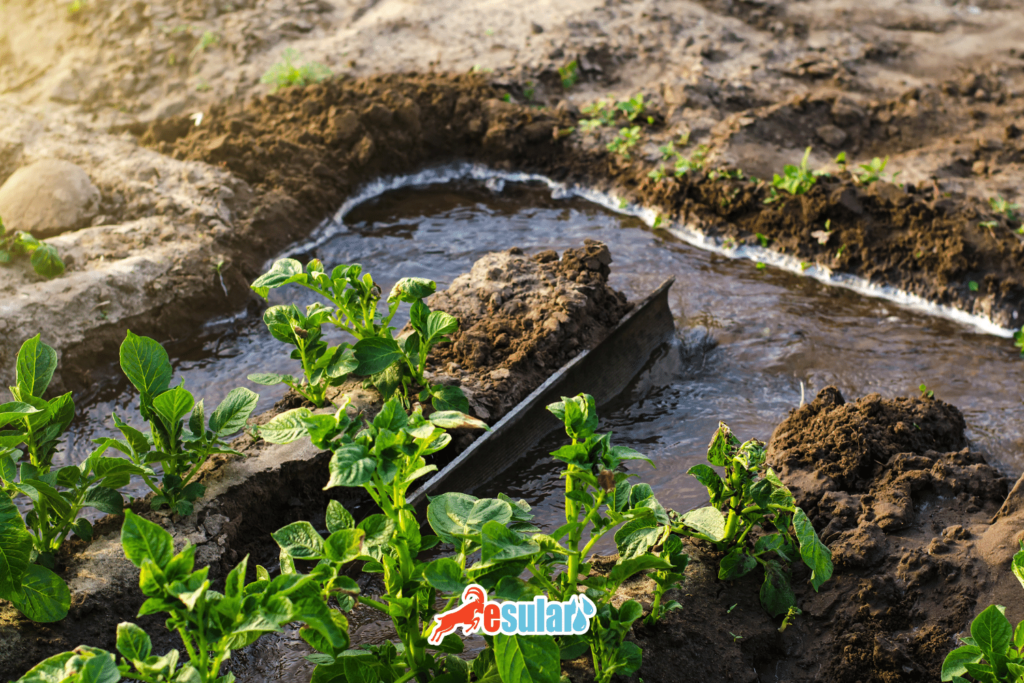
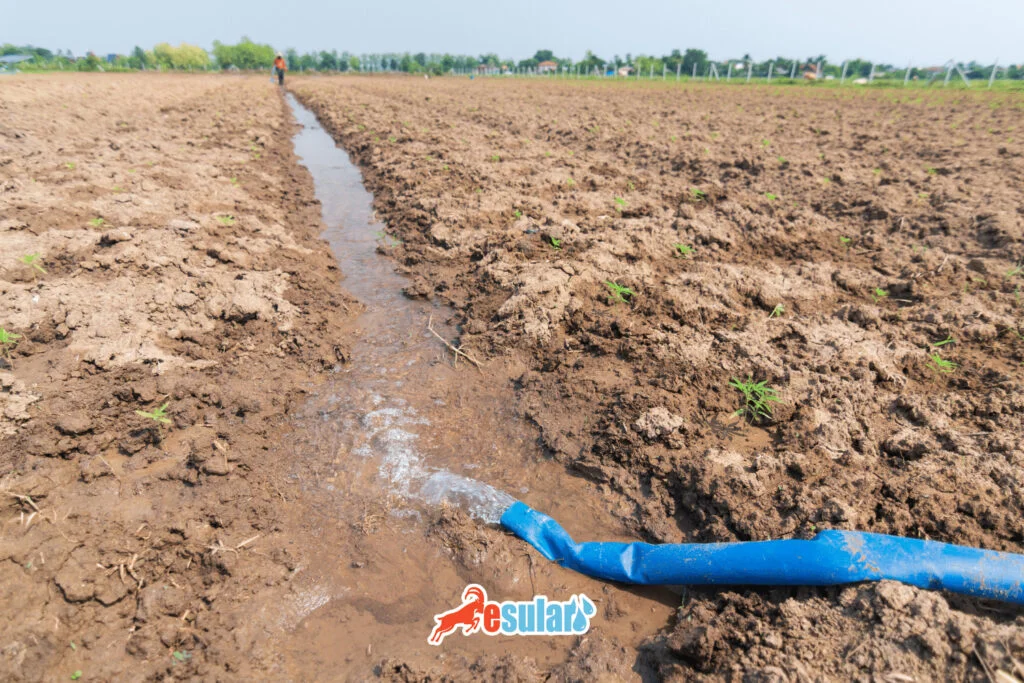
Furrow irrigation is one of the agricultural irrigation methods and is generally used on sloping lands. The small grooves created between plant rows are called furrows, and the irrigation method carried out by providing water through these grooves is called Furrow irrigation. While the water moves along the furrow, it also seeps into the soil and is stored in the plant root zones. This method is an effective irrigation method widely used in regions with certain conditions and suitable topographical features, but the characteristics of the area where it will be applied must be taken into account.
What are the Conditions Under Which the Method Can Be Applied?
This method is applied to plants sown or planted in rows, in vineyards, and in fruit trees.
In lands where furrow irrigation is applied, land leveling is very important. Generally, the slope should be at most 3% in the direction of irrigation and 15% in the direction perpendicular to the irrigation.
The soil types suitable for this method are generally soils with a sandy or clayey structure and good drainage characteristics. These soils allow water to be absorbed quickly and the roots of the plants to reach the water easily.
This method is not preferred in saline soils. Because the water given to the furrows rises to the furrow ridges and carries the salt to the plant root zone.
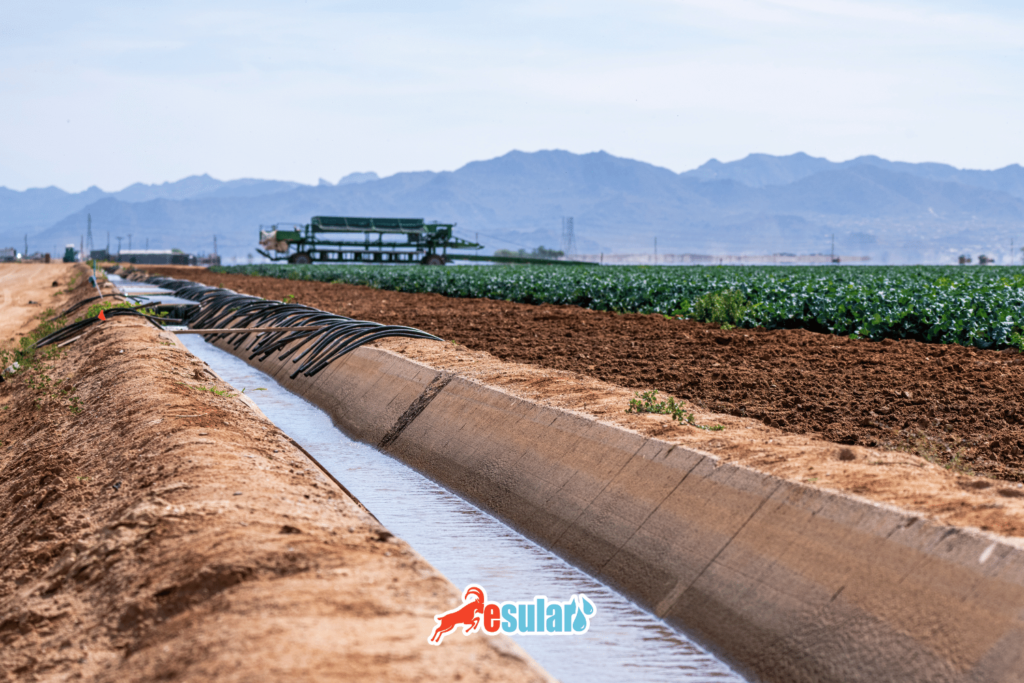
The water source is also important for the furrow irrigation system. A water source, usually a stream or a pond, is needed for the supply of irrigation water. This water source should be easily accessible to the field and have sufficient flow rate for the irrigation process.
How is Furrow Irrigation Done?
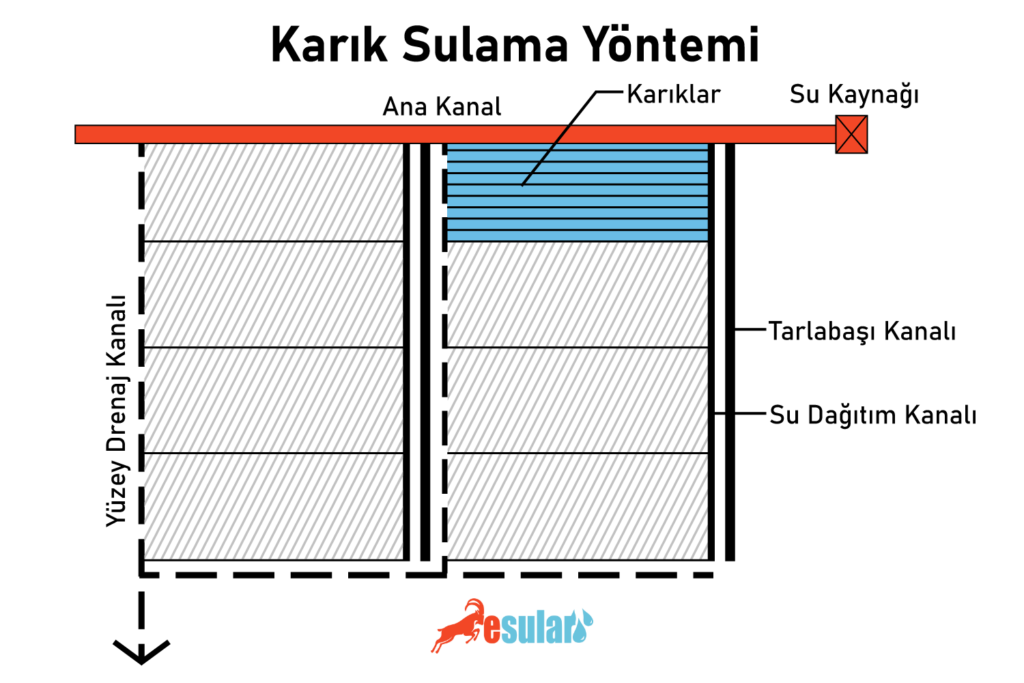
In this method, water is directed towards the plants on the field through furrows placed along the irrigation line. The first step is to determine the irrigation line and select the appropriate location on the field. Then, channels are dug considering the slope of the field, and the distance between these channels is determined according to the needs of the plants. The water taken from the water source is directed to the created channels and slowly advances along these channels to reach the root zones of the plants. This process is arranged to meet the water needs of the plants and ensures that the water is distributed homogeneously within the field. Later, the water leaving the furrows is discharged through surface drainage channels or used again in irrigation. The furrow types used in this method are as follows;
Fixed-flow open furrows: Water is given to each furrow at a constant flow rate while irrigating. The rotational use of this water increases irrigation efficiency.
Variable-flow open furrows: Used in cases where the water leaving the furrows cannot be reused. When the water reaches the end of the furrow, the flow rate is reduced to try to increase irrigation efficiency.
Closed furrows: The beginnings and ends of the furrows are closed. It is applied by creating ponding. It is applied in conditions where there is no slope in the direction of irrigation, or where the height difference between the furrow ends does not exceed the net irrigation water depth.
Advantages of the Furrow Irrigation Method
Initial installation cost is low.
It allows irrigation of other plants without changing the system design.
If land leveling is well-provided, its efficiency can be increased.
It can be used easily in heavy-textured soils that form a crust layer.
It generally does not require regular maintenance.
Since it is a simple system, energy consumption is low.
Disadvantages of the Furrow Irrigation Method
With the furrow irrigation method, the water application efficiency to the field under ideal conditions is generally around 60%. However, when factors such as seepage, evaporation, and operational losses in the network are added, this efficiency drops to approximately 50%. In other words, to give 1 m³ of water to the plant, 2 m³ of water is actually used. In this case, efficiency is low in terms of effective use of water.
Irrigation efficiency is low in cases where the water leaving the furrows cannot be controlled.
Salt accumulating on the furrow ridges can cause damage to plants by increasing soil salinity.
In cases of excessive precipitation, surface runoff accumulates in the furrows and can increase the erosion problem.
As a result, in this period where available water resources are limited, we must use our limited water resources most effectively. Contrary to popular belief, our country is among the water-poor countries according to the index of available water per capita. We use approximately 70% of our current water potential in the agricultural sector. A 1% saving in the agricultural sector can lead to major changes in the industrial sector and domestic use. For this reason, by reducing our agricultural water consumption rate using modern irrigation techniques, we can invest in both the national economy and our future. You can examine our site to get more detailed information about modern irrigation systems.