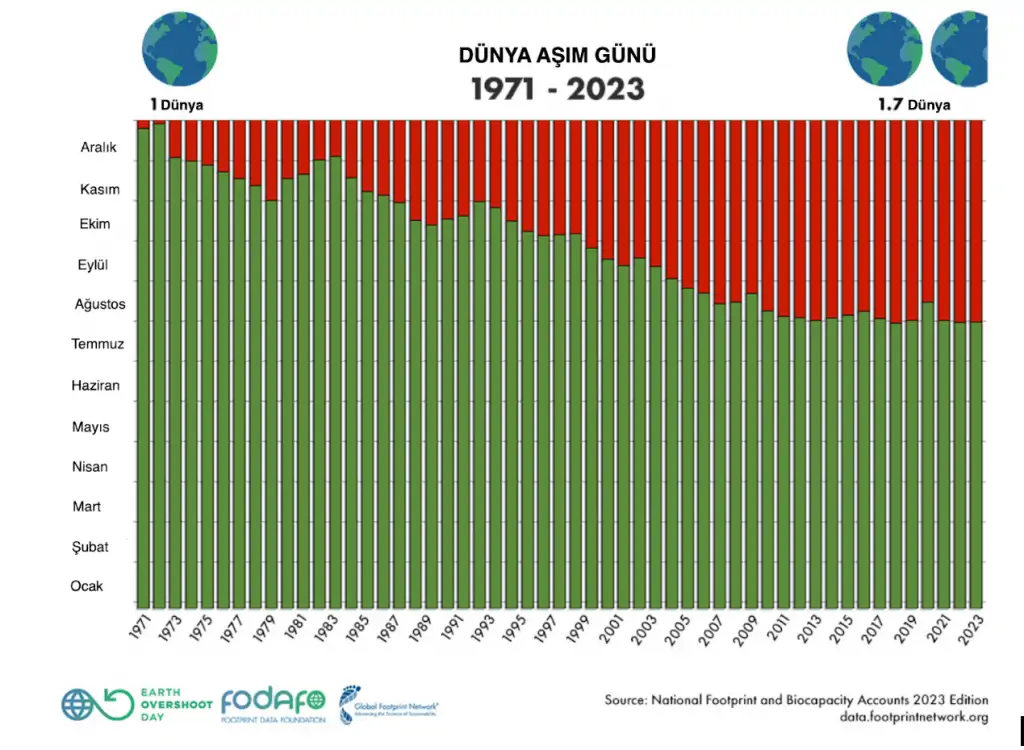
As of this week, we have consumed nature's annual budget. August 2, 2023, was Earth Overconsumption Day. This is the estimated date when humanity exceeds the ecological resources that Earth can regenerate for this year. In only the 30th week of 2023, we demanded ecological resources and services equal to the level Earth can regenerate in an entire year, from food to raw materials, from fossil fuel emissions to the capacity to absorb carbon dioxide. For the rest of the year, we will spend from a state of ecological overshoot.
Earth Overconsumption Day is an annual event that aims to draw attention to the risks of humanity's growing ecological debt. Making more conscious choices increases our possibility of reversing these trends and moving toward a sustainable future; measuring how much nature we have, how much we use, and how much we need helps us make these choices.
To reach the United Nations' IPCC target, we need to reduce global carbon emissions by 43% by 2030 compared to 2010. This requires pushing Earth Overconsumption Day back by 19 days every year for the next seven years. Simple changes can significantly affect the date of Earth Overconsumption Day in the form of #ChangeTheDate: Increasing the global share of low-carbon electricity sources from 39% to 75% moves the date back by 26 days; cutting food waste in half gains 13 days.
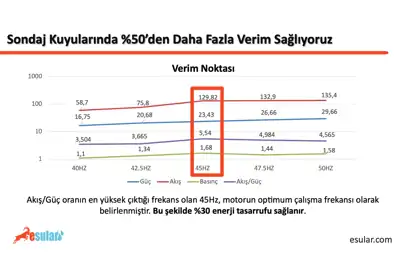
Agricultural activities, especially irrigation and energy use, are directly related to Earth Overconsumption Day. Agriculture uses natural resources such as water, soil, and energy intensively. Effective and sustainable management of these processes is important to prevent us from exceeding Earth's annual biological capacity. Irrigation plays an important role in agricultural production but also consumes large amounts of water. Overuse of water resources can increase water stress and reduce biocapacity, which can cause Earth Overconsumption Day to fall on an earlier date. Similarly, agricultural energy processes also consume natural resources significantly. These processes generally involve the use of fossil fuels, which increases the carbon footprint and greenhouse gas emissions. This can exceed Earth's capacity to absorb carbon emissions and lead to Earth Overconsumption Day occurring at an earlier date. As a result, making agricultural activities more sustainable, especially in terms of irrigation and energy use, can positively affect the date of Earth Overconsumption Day. This includes actions such as increasing water and energy efficiency, managing natural resources more effectively, and transitioning to energy sources with lower carbon emissions.
To determine the date of Earth Overshoot Day each year, Global Footprint Network calculates the number of days that Earth's biocapacity is sufficient to meet humanity's Ecological Footprint. The remainder of the year represents global overshoot. Earth Overshoot Day is found by multiplying the ratio between the planet's biocapacity (the amount of ecological resources Earth can produce within that year) and humanity's Ecological Footprint (humanity's demand for that year) by 365, the total number of days in a year:
(Planet's Biocapacity / Humanity's Ecological Footprint) x 365 = Earth Overconsumption Day
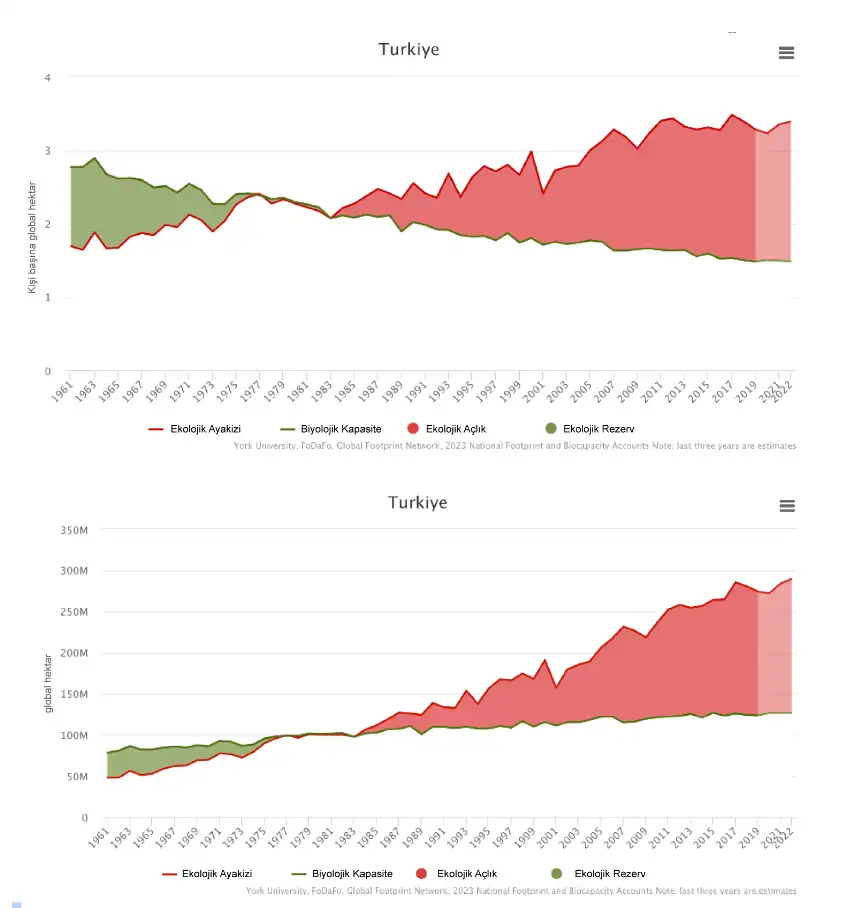
The following graphs reveal Turkey's ecological footprint and biological capacity, and the difference between these stocks.
The past does not necessarily determine our future. Our current choices do. With wise, forward-looking decisions, we can reverse natural resource consumption trends while improving the quality of life for all people. Although our planet is finite, human possibilities are not. The transformation to a sustainable, carbon-neutral world will be successful when we apply humanity's strengths such as foresight, innovation, and caring for one another. The good news is that this transformation is not only technologically but also economically beneficial and is the best chance for a prosperous life in the future.
The current trend is not our destiny: #PostponeTheDate