Tüm Yazılar
How is Pistachio Cultivation Done?
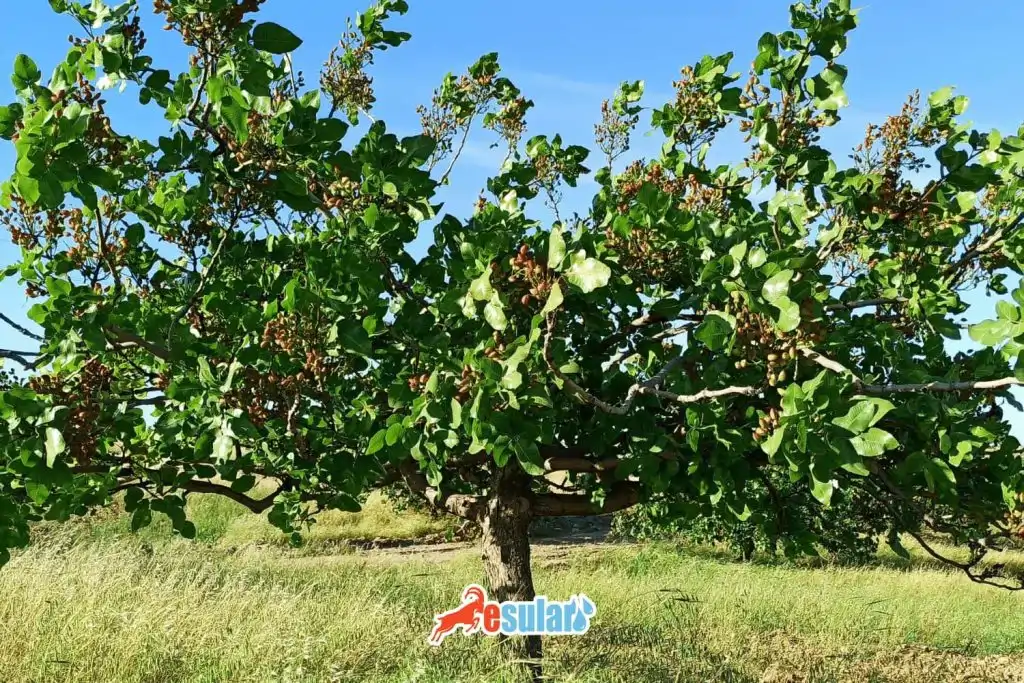
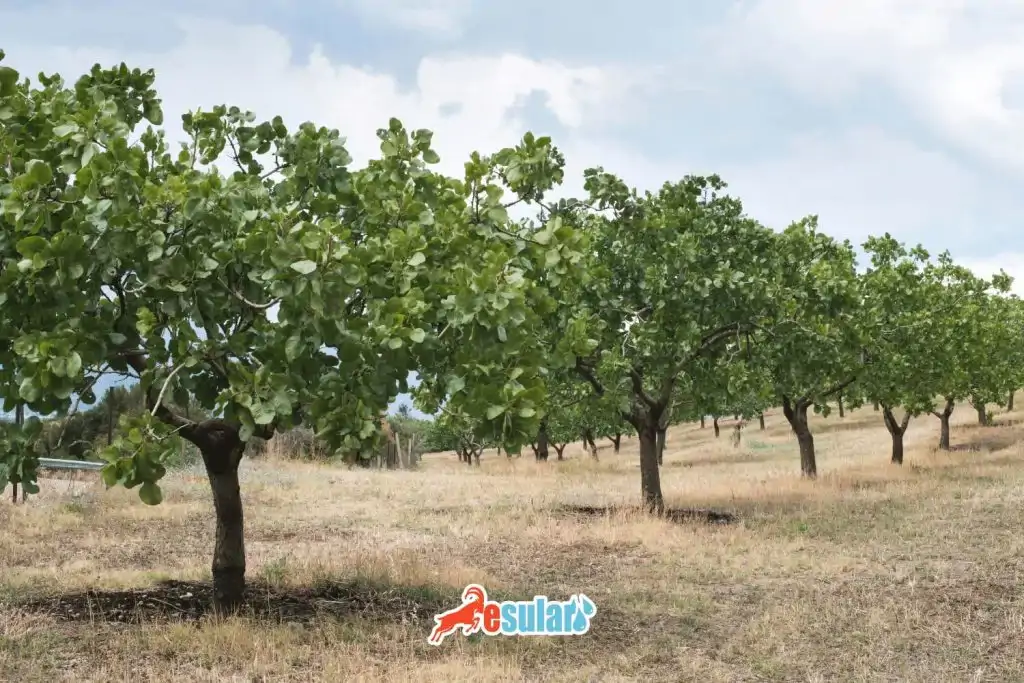
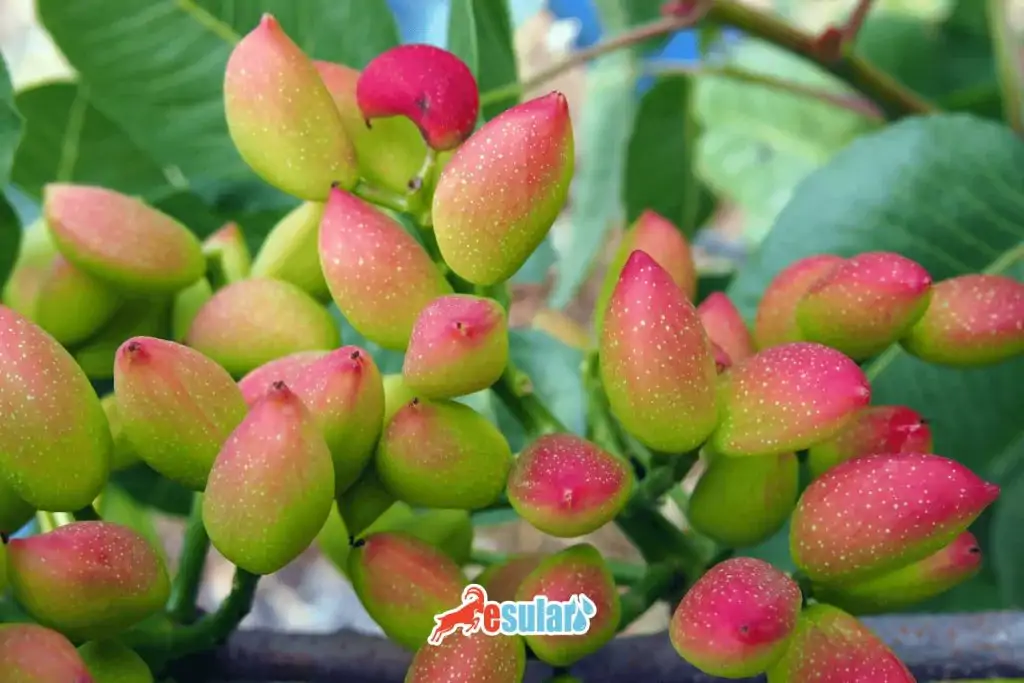
Pistachio cultivation is a valuable agricultural activity widely practiced in regions where the Mediterranean climate prevails. This delicious nut, which grows directly in the Southeastern Anatolia Region and other Mediterranean coasts, is one of our country's important sources of agricultural income. Pistachio (Pistacia vera) is produced in large areas, especially in regions such as Gaziantep, Şanlıurfa, and Kilis, where the soil and climate are suitable. Although its cultivation is a laborious process requiring patience, it is a significant source of income for farmers with its high yield and economic returns. Among the orchard establishment methods, options such as seed sowing, rootstock planting, and containerized seedling planting are available. Careful management of factors such as irrigation, fertilization, and pest control is important for successful pistachio cultivation. Pistachio, an indispensable flavor of Mediterranean cuisine, has an important place in both the domestic market and foreign trade.
Climate and Soil Structure in Pistachio Cultivation
Although the pistachio tree is generally a frugal species, it prefers dry and hot climate conditions. This plant, which has high temperature requirements, is resistant to low temperatures and even winter frosts during the winter months. However, with the arrival of spring, it does not like low temperatures and can be damaged by spring frosts. For this reason, in places where pistachio orchards will be established, regions with low frost risk should be preferred. In terms of soil structure, although the pistachio tree can generally grow in shallow, low-fertility soils, it prefers deeper and more fertile soils. Deep and light-textured soils with a pH level between 7.5 and 8.5, without salinity problems, are ideal for pistachios. However, pistachios can be damaged in soils with drainage problems and low aeration. Especially in bottom lands with a heavy clay structure, a pistachio orchard should not be established without providing drainage.
Seedling Planting in Pistachio Cultivation
Seedling planting is carried out during the period when the tree sheds its leaves in pistachio cultivation. It is generally suitable from November until the end of March. Seedlings are moved to pre-determined planting areas and planting pits are opened. The depth of the pits is prepared to be at least 60 cm and the width 40 cm. The topsoil is separated and mixed with well-rotted organic fertilizer to fill the pit. Seedlings are placed in these prepared pits. The roots of the seedlings are filled with soil, ensuring no air pockets remain. After the planting process, life water (can suyu) must be given to the seedlings. Additionally, it is important to check the grafting point and improve it if necessary. A stake (herek) is planted to ensure the healthy growth and development of the seedlings. The seedling is tied to this stake to create a straight trunk. Finally, necessary precautions should be taken to prevent sunburn and harmful organisms. Correct application of these steps ensures that pistachio seedlings grow healthily and are raised productively.
Fertilization in Pistachio Cultivation
Fertilization is an important issue in pistachio cultivation. Increasing soil organic matter improves the physical properties of the soil, increases its resistance to erosion, and facilitates the uptake of nutrients by plants. Therefore, practices aimed at increasing soil organic matter are recommended. Green manuring, compost application, and the use of organic fertilizers are among the effective ways to increase soil organic matter. Incorrect practices in fertilization can reduce the organic matter content of the soil and cause various negative effects. Therefore, it is important to perform correct applications based on soil and leaf analyses regarding fertilization. Fertilization should be done according to soil and leaf analysis results, and the type and amount of fertilizers should be determined accordingly. The soil should not be harmed by hearsay information or by unnecessarily increasing the use of chemical fertilizers.
In pistachio orchards, leaf analyses should also be performed in addition to soil analyses, and it should be determined whether there is a nutrient deficiency in the plants. Especially in soils with high lime content, plants cannot take up iron and zinc. In this case, foliar fertilization is recommended. However, while fertilizing, it is important to perform correct applications based on soil and leaf analyses.
Irrigation in Pistachio Cultivation
Although pistachio trees are resistant to drought, they need water especially during the nut formation period. The irrigation program should be adjusted according to the climate conditions of the region, soil structure, and the age of the trees. The water requirement of pistachio trees increases especially before and during the start of nut formation. While young trees are irrigated more frequently, older trees need deeper and less frequent irrigations. During irrigation, it is important to give water directly to the root collar of the trees. This ensures that the roots access water more easily and the water is absorbed efficiently. Additionally, a careful irrigation technique should be used to prevent irrigation water from accumulating in the root zone and to ensure the effective distribution of water.
Preferred irrigation systems for pistachio cultivation include drip irrigation and sprinkler irrigation. Drip irrigation prevents water waste and reduces plant stress by providing water directly to the root zones. Sprinkler irrigation is effective for irrigating large areas and ensures a homogeneous distribution of irrigation water. However, the sprinkler irrigation method may consume more water as it is more open to water evaporation and distribution by wind. To get information about smart irrigation systems in pistachio cultivation, you can review our article: https://esular.com/antep-fistigi-tarlasinda-otomatik-sulama-uygulamasi.
Pistachio Harvest
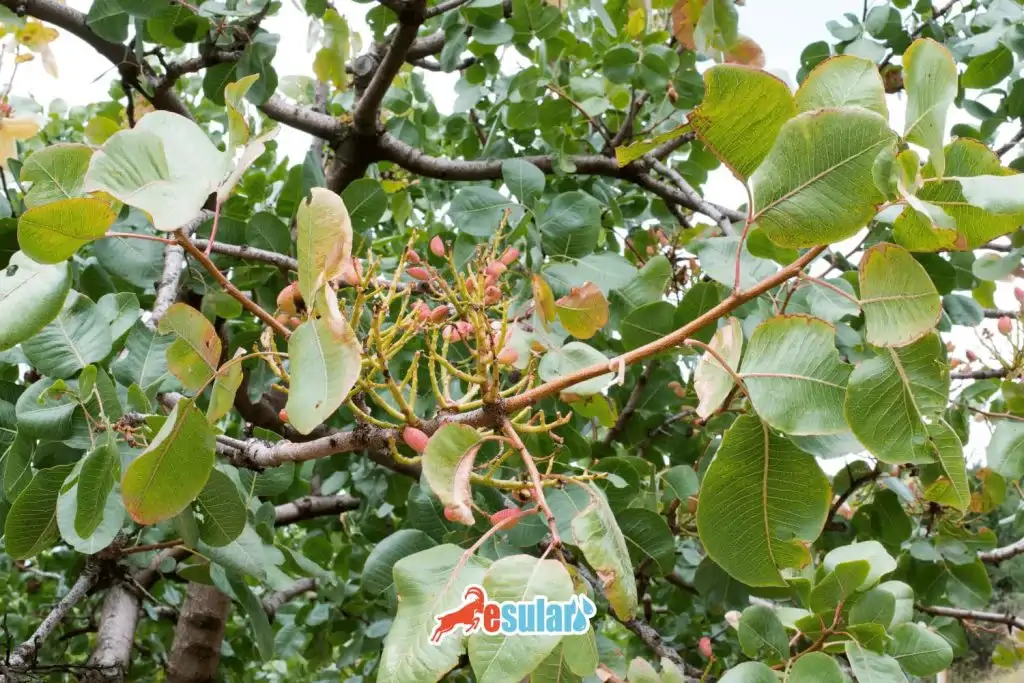
Pistachio harvest should be carried out when the fruits reach harvest maturity. During this period, the outer shell of the fruit turns from a transparent state to a matte appearance. The red hull softens and separates easily from the hard shell. Fruits show a distinct cracking in their inner shells and the kernel is fully developed. When harvested early, the fruit kernels usually remain green and are considered immature. Late harvest can cause the red hull to shrink and dry out. Additionally, lightening of the inner fruit color and quality losses may also occur. For this reason, careful attention should be paid to the maturity of the fruits at harvest time.
Pistachio harvest is generally carried out by hand-picking the clusters (cumbalar). It is important to pick the clusters in the opposite direction of the cluster slope and from where the cluster stem joins the branches. Instead of picking any fruit individually by hand, picking the entire cluster together is a more effective and efficient method. Empty cluster stems and fruits remaining on the tree during harvest can create a suitable shelter for pests. Therefore, cleaning should be done in the orchard after harvest and the trees should be inspected regularly.
How Many Years After Planting Does a Pistachio Tree Bear Fruit?
A pistachio tree generally starts to bear fruit within 3 to 4 years after being planted. However, it may usually take until the end of the 6th year to fully settle into production and provide maximum yield. Under proper care and conditions after planting, a pistachio seedling with a 2-year-old wild pistachio rootstock grows and matures rapidly. This can accelerate the fruit-bearing process. However, the process of starting to bear fruit and the productivity of each tree can vary depending on various factors, so this is a general guide.
How Much Pistachio is Produced from 1 Decare?
Pistachio yield can vary depending on many factors, but generally, an average of 150 to 300 kilograms of pistachios can be obtained from a one-decare land under ideal conditions. This yield can change depending on cultivation methods, irrigation schedule, soil quality, climate conditions, and various other factors. When good care and management are applied, productivity can increase and higher amounts of pistachios can be obtained.
What are the Diseases and Pests Seen in Pistachio Cultivation?
Some diseases and pests encountered in pistachio cultivation are as follows:
-
Pistachio Psyllid: An insect species that damages the leaves and negatively affects pistachio development.
-
Pistachio Shoot Moth: A moth species that causes damage by opening galleries in the shoots. It can cause leaf and fruit drop.
-
Pistachio Bud Weevil: A harmful insect species that feeds on buds and shoots. It can cause yield loss and shoot drop.
-
Pistachio Fruit Moth: A moth species that lays its eggs inside the fruit and is harmful within the fruit.
-
Pistachio Bark Beetle: An insect species that is harmful on dry branches and causes trees to dry out.
-
Pistachio Scale Insect: An insect species that feeds on leaves and negatively affects fruit development.
-
Pistachio Black Fruit Borer: A species that is harmful inside the fruit. It can cause damage by turning the outer shell of the fruit brown.
-
Pistachio Karazenk: A fungal species that causes disease in leaves and fruits. It creates pycnidia on leaves and can reduce fruit quality.
These diseases and pests are important problems that must be considered in pistachio cultivation and they must be brought under control with appropriate management methods.
Kategoriler