Measuring Water in the Soil with Electricity: Dielectric Constant, Water and TDR Technology
At the foundation of making correct irrigation decisions in agriculture liesknowing how much water is in the soil. However, it is not possible to see the water in the soil directly. On the other hand, the interaction of water with electric fields is extremely strong. This is exactly where modern soil moisture sensors come into play.
In this article;
why water is a "special" substance,
the concept of dielectric constant (relative permittivity),
how this physical propertyhas become measurable with TDR (Time Domain Reflectometry)technology
Water is Not a Dielectric (But It Has a Dielectric Constant)
Let's start with a common conceptual error: Water is not a "dielectric." However, water has a dielectric constant.Although the current and technically correct term is “relative permittivity (εr),” we will use the expression “dielectric constant” in this article due to its common usage.The dielectric constant is a dimensionless number that shows how much a substance can be polarized under an electric field. The reference for comparison is vacuum (εr = 1).
What is Dielectric Constant?
Imagine a capacitor consisting of two parallel metal plates. The capacitance of this capacitor is the ratio of the amount of charge stored on the plates to the applied voltage:
Capacitance = Q / E
This capacitance depends on the material placed between the plates:
Vacuum → Reference
Air → Very little increase
PTFE (Teflon) → ε ≈ 2.1
Pure water → ε ≈ 80
What does this mean?
Under the same electric field:
PTFE can store more than 2 times,
Pure water can store approximately 80 times more electrical energy compared to vacuum.
Therefore, water interacts extremely strongly with electric fields.
Why Does Water Have Such a High Dielectric Constant?
The answer to this lies in the structure of the water molecule.
Water Molecule (H₂O):
Oxygen (O):δ– (partial negative charge)
Hydrogen (H):δ+ (partial positive charge)
Oxygen's electronegativity is higher than hydrogen's. For this reason, it pulls the bonding electrons towards itself and the molecule becomespolar.
Thanks to this structure, water:
Is a polar molecule
Forms hydrogen bonds
Polarizes very strongly under an electric field
Has a high dielectric constant
Dissolves many ioinic substances easily
This is also the reason why ions dissolve easily in water: Charged particles attract each other withapproximately 1/80 less forcein water compared to vacuum.
Dielectric Constant is Not Constant: Temperature and Frequency Effect
The relative permittivity of water changes depending on bothtemperatureandfrequency.
Static (Low Frequency) Values:
0 °C → εr ≈ 88
20 °C → εr ≈ 80
25 °C → εr ≈ 78
100 °C → εr ≈ 55–57
Frequency Dependency (Approximate):
DC – MHz → Static values apply
2.45 GHz (microwave) → εr ≈ 70–78
Around 10 GHz → εr ≈ 60–70
Infrared / visible light → εr ≈ 1.77
For this reason:
In electrostatic and low-frequency applicationsstatic values are used
In RF, microwave and optical applicationsfrequency-specific dielectric models are required
Conductivity and Dielectric Property are Not the Same Thing
Another common misconception: "Water conducts electricity."
In reality:
Very pure water is almost an insulator
Its resistance can reach the level of18,000,000 Ohm·cm
The conductivity of water depends on impurities such as salts, minerals, and evenCO₂dissolved from the air.
In soil moisture measurement, what is measured is:
Not current
The interaction of the electric field with the environment
That is, not conductivity, butdielectric propertiesare essential.
What is TDR (Time Domain Reflectometry)?
TDR is a method that has been used for decades as thegold standard in soil water content measurement.
The basic principle is this:
Electromagnetic pulses are sent along metal rods (waveguides)
Pulses slow down depending on the electrical properties of the medium
The travel time of the reflected signalsis measured
The slower the pulse travels, the more permittivity (i.e., water) the surrounding medium has.
Permittivity – Pulse Travel Time Relationship
The permittivity of the medium surrounding the waveguides has a direct effect on the travel time of the pulse.
Permittivity of water ≈80 Soil minerals ≈3–7 Air ≈1
Due to this large difference, even small changes in the amount of water in the soil are clearly detected in TDR measurements.
The ratio of the pulse travel time to the time it would have if the waveguides were in air is expressed asapparent permittivity (Ka). There are many scientific models that calculate water content from this value.
How is soil moisture measured with TDR?
The TDR method measures the travel time of electromagnetic pulses sent into the soil. Due to the high dielectric constant of water, as the amount of water in the soil increases, the pulse travels slower. Using this time difference, soil moisture is calculated with high accuracy.
Challenges of Real TDR Systems
Classic TDR systems:
Are complex and expensive
Require advanced signal processing algorithms
Are sensitive to noise
Accurate detection of start and end points is critical
For this reason, they have been used only in research and laboratory applications for a long time.
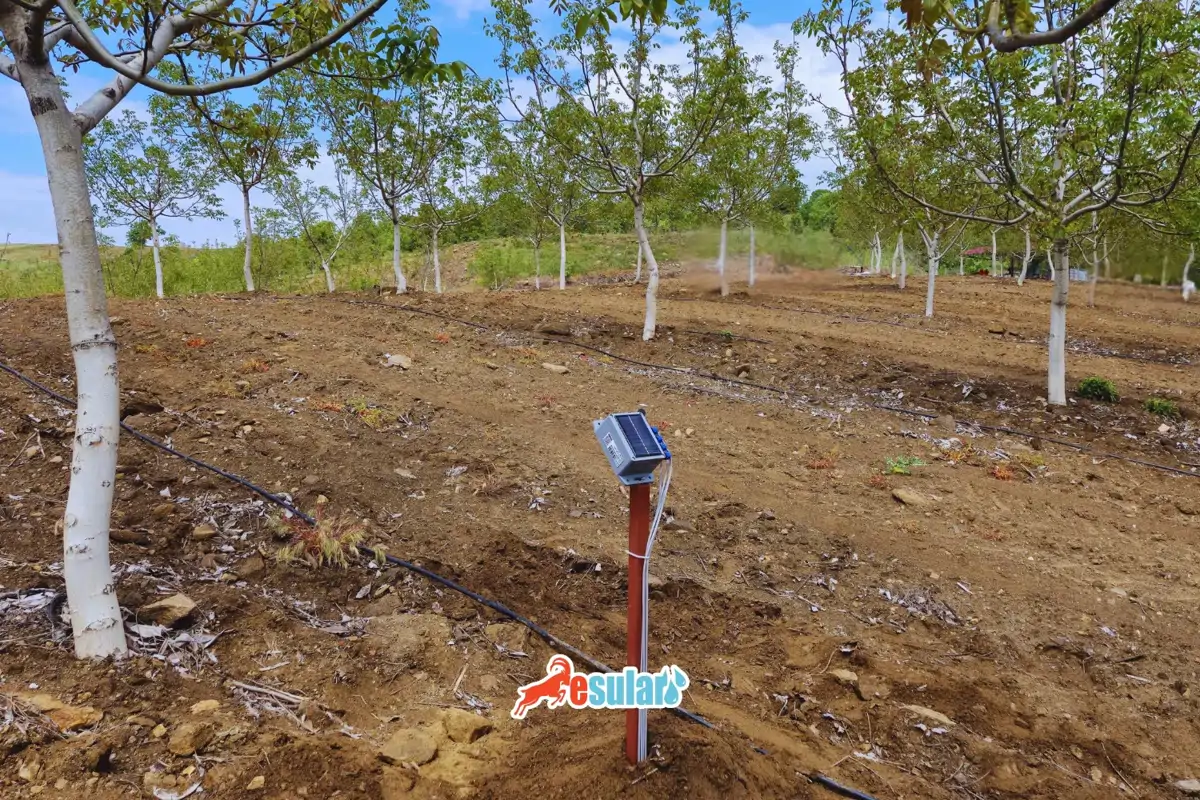
ESULAR Smart-soil TDR: The Solution Bringing Science to the Field
The entire system is designed to produceaccurate and repeatable measurementwithout expecting complex settings from the user.
Conclusion: The Scientific Way of Measuring Soil Moisture
Water interacts strongly with electric fields thanks to its high dielectric constant.This property becomes measurable with TDR technology.TDR, in turn, forms the basis of correct irrigation, yield increase, and sustainable agriculture.ESULAR Smart-soil TDR, transforms this physical fact into a reliable measurement in the field.
For More Information
You can visit our Smart-soil product page and see how esular soil moisture sensors make a difference in agriculture.