How to Choose the Best Soil Water Content Sensor for Your Application?
Choosing a soil water content sensor is a critical step for many applications such as agriculture, landscape management, irrigation automation, research, or environmental monitoring. However, since there are many types of sensors on the market, choosing the right sensor can seem complex from time to time.
In this article, we will discuss in detail, based on a scientific foundation, what a sensor actually measures, the technical principles that make a good sensor good, and how manufacturer specifications should be interpreted.
The goal is to make your sensor selection process informed and safe.
What Do Soil Water Content Sensors Actually Measure?
Many users think that soil water content sensors directly measure the water inside the soil. However, none of the commercial sensors measure water by "physically separating" it.
Instead, sensors measure other physical properties that change with the presence of water in the soil. Chief among these properties are:
Dielectric permittivity
Thermal conductivity
Neutron flux density
come first.
This article focuses on dielectric permittivity measurement, which is the most widely used technique in the world.
What is Dielectric Permittivity?
Dielectric permittivity (or “dielectric constant”) is the energy storage capacity of a substance under an electric field.
The soil contains:
mineral particles
organic matter
air
water
and the behavior of each component under an electric field is different.
Water stores approximately 10 times more energy under an electric field than mineral and organic substances.
Therefore, the more water there is in the measurement zone, the higher the dielectric constant will be.
Why Does Water Store This Much Energy?
Because water is a polar molecule. What does this expression mean?
A water molecule (H₂O) has positive and negative charge centers due to the bond angle and electron distribution between the hydrogen atoms and the oxygen atom.
Therefore, when an electric field is applied:
water molecules try to align
they spend energy to change direction
this energy becomes electrically storable
This is how sensors can measure water thanks to this behavior.
How Do Dielectric Permittivity Sensors Work?
The sensor sends an electric field into the soil and measures the electrical response of the soil.As the dielectric constant changes, the electrical response changes.Then the sensor performs this conversion:
Electrical signal → Dielectric constant → Volumetric water content
The technologies used in this process are different:
Main Dielectric Sensor Technologies
TDR (Time Domain Reflectometry)
Electromagnetic signal is sent
Reflection time is measured
Offers high accuracy
Common in research
FDR (Frequency Domain Reflectometry)
Signals are sent at different frequencies
Highly sensitive
Energy consumption is low
Capacitive Sensors
Capacitance change between two electrodes is measured
Economical
Common in agricultural applications
Coaxial Probe Methods
Used in industrial designs
Resistant to noise
Each technology has different advantages, so the choice should be made according to the application.
Why Are Temperature, Salinity, and Soil Structure Important?
Dielectric permittivity is not only dependent on water.
The following factors can affect the measurement:
temperature change
conductivity change (especially if EC is high)
clay ratio
organic matter amount
For this reason, manufacturers' accuracy values are taken under laboratory conditions.In real field conditions, accuracy is generally lower.One must definitely pay attention when choosing a sensor.
What Should a Good Soil Water Content Sensor Be Like?
The following features are of critical importance:
Accuracy
Especially important in field capacity and wilting point analyses.
Resolution
The smallest change the sensor can detect.
Range
Measurement capability in the dry – saturated range of the soil.
Durability
Must withstand UV, humidity, chemical, and mechanical effects.
Calibration
Some sensors require specific calibration for the soil type.
Price
A price/performance balance should be sought according to the purpose of application.
How to Interpret Manufacturer Specifications?
The accuracy of a sensor is affected by the following elements:
electrical measurement accuracy
temperature compensation
conversion functions
adaptation to soil type
salinity tolerance
For example: The statement “±1% volumetric water accuracy” can usually go up to the ±3%–±5% level in a real field.
Also, most sensors measure less accurately at low water levels.
What is Resolution?
For example, if a sensor: has a 0.1% resolution, it can detect when the water ratio in the soil increases from 20% to 20.1%. The higher the resolution, the more precise the data.
Operating Range
Some manufacturers give a 0% – 100% range. This is theoretical. Some say 0 – 0.5 m³/m³ (this equals 0%–50% water). According to soil type:
sandy soil: 20%–30%
clayey soil: 40%–60%
organic soil: 60%–70% can go up in water content.
The sensor range must be suitable for the soil type.
Summary
There is no perfect sensor.There is the most suitable sensor for your application.To choose the most accurate sensor, it is necessary to know:
the measurement technology
the dielectric logic
the environmental effects
the accuracy values
the resolution
the calibration it is necessary to know.
When you understand this information, comparing sensors becomes easier and your investment becomes safer.
Irrigate Your Soil by Measuring, Not by Guessing
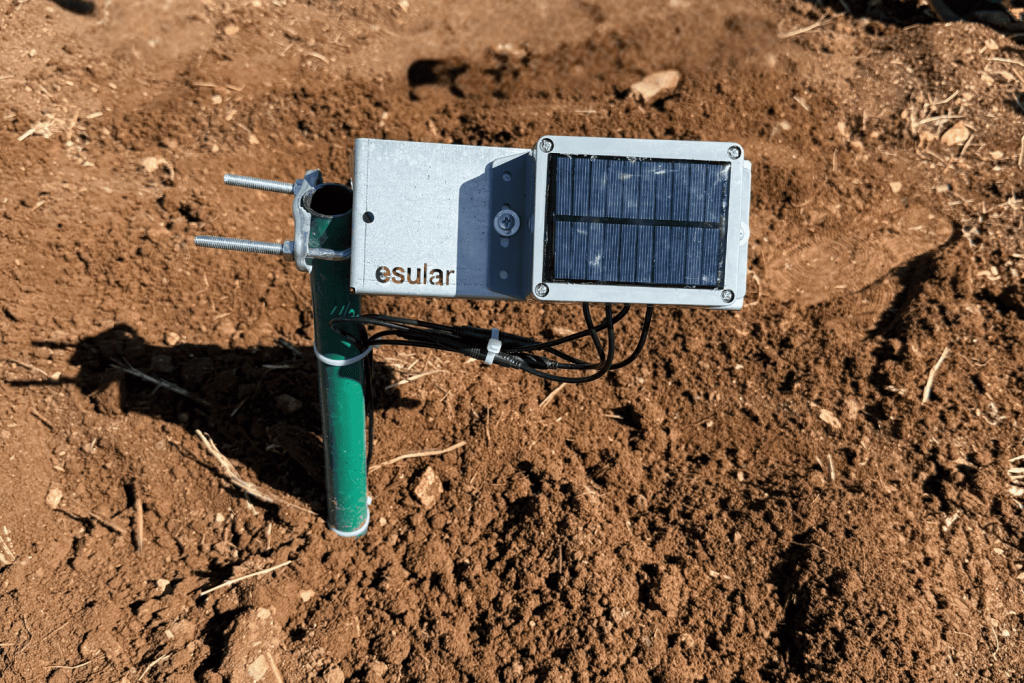
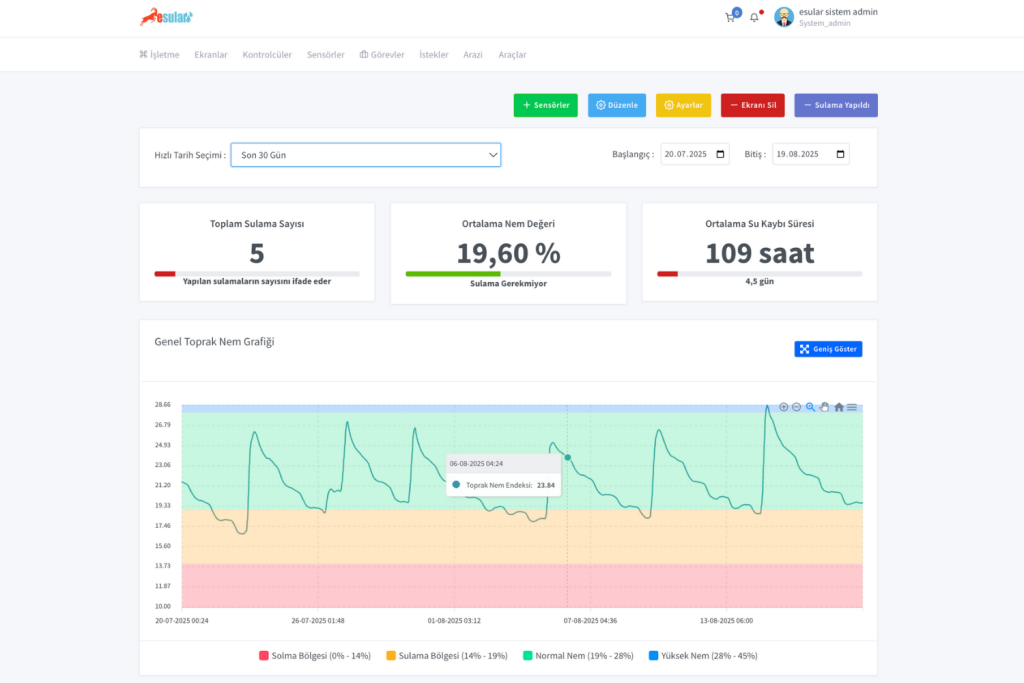
Every soil type holds water differently. To make correct irrigation decisions, field capacity and wilting point values must be measured in real-time. Esular soil moisture sensors, offer you the opportunity to irrigate at the right time and in the right amount by continuously monitoring the volumetric moisture values of your soil.