Latch Solenoids use an electric current pulse or an internal permanent magnet to maintain a set position without using a constant electric current.
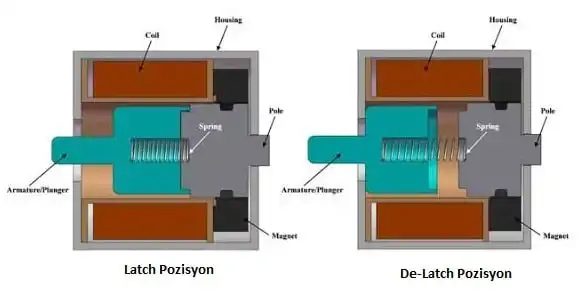
Although the operating principle is similar to all linear solenoids, the role of electrical polarity in the operation to be applied in Latch solenoids is slightly different. While current flows in a direction that energizes the coil field in the solenoid, it contributes to the attraction of the permanent magnet. The armature, on the other hand, is pulled towards the fixed pole within the solenoid body.
When the armature moves fully and contacts the pole, it will remain in this position without further electrical input. The armature is held in this position by the permanent magnet. To remove the solenoid from this holding position, the attraction of the “holding” magnet must be canceled by sending a current in the opposite direction through the coil field.
Latch solenoids operate efficiently in cases where the pulse duration is much shorter compared to the holding time. While the Latch solenoid can be used in both short and long stroke applications, the solenoid stroke should be minimized to increase efficiency.
There are two main types of Latch solenoids:
Permanent Magnet (PM) Latch solenoid actuators use permanent magnets in conjunction with the solenoid coil to maintain the position of the armature when no current is applied. The permanent magnet produces a small magnetic flux in the magnetic circuit that creates an attraction between the armature and the fixed pole piece without power being applied. When a short pulse of electric current is applied to the coil, the electromagnetic flux generated by the coil can either add to or subtract from the permanent magnet flux, depending on the polarity of the applied current.
In applications where the load moves to extend the armature away from the fixed pole, Latch solenoids can remain in the extended or retracted position without consuming continuous power. In applications where there is no load acting on the armature, a spring can be used to hold the armature in the extended position. In both cases, a current pulse is applied to add to the permanent magnet and generate magnetic flux to move the armature to the fixed pole piece. When the current is removed, the armature is held in the “latched” position by the permanent magnet. Conversely, applying a reverse polarity pulse will cancel the permanent magnet flux, allowing the load or spring to release the armature and move it to the extended position.
Residual Magnetism (RM) latching solenoid actuators operate similarly to how permanent magnet latching actuators do. However, there are some unique design differences. While both types of latching solenoid actuators maintain the latched position without electricity, residual magnetism actuators remain latched without the use of permanent magnets. RM latching actuators offer the same benefits as PM latching actuators, consuming no power, generating no heat, and producing no electrical noise when in the latching position. RM latches utilize the inherent “residual magnetism” common in all DC actuators, enhanced with special internal design features to provide exceptional latching force without permanent magnets. Engaging the RM actuator is accomplished by providing a short pulse of electric current of any polarity to pull the armature to the fixed pole piece and “latch” it. Releasing the actuator is accomplished by applying a low current pulse of the opposite polarity to that used to latch the actuator. Unlike PM latching actuators, which can be latched manually, RM latching actuators cannot be reset after latching without applying an electric current pulse.
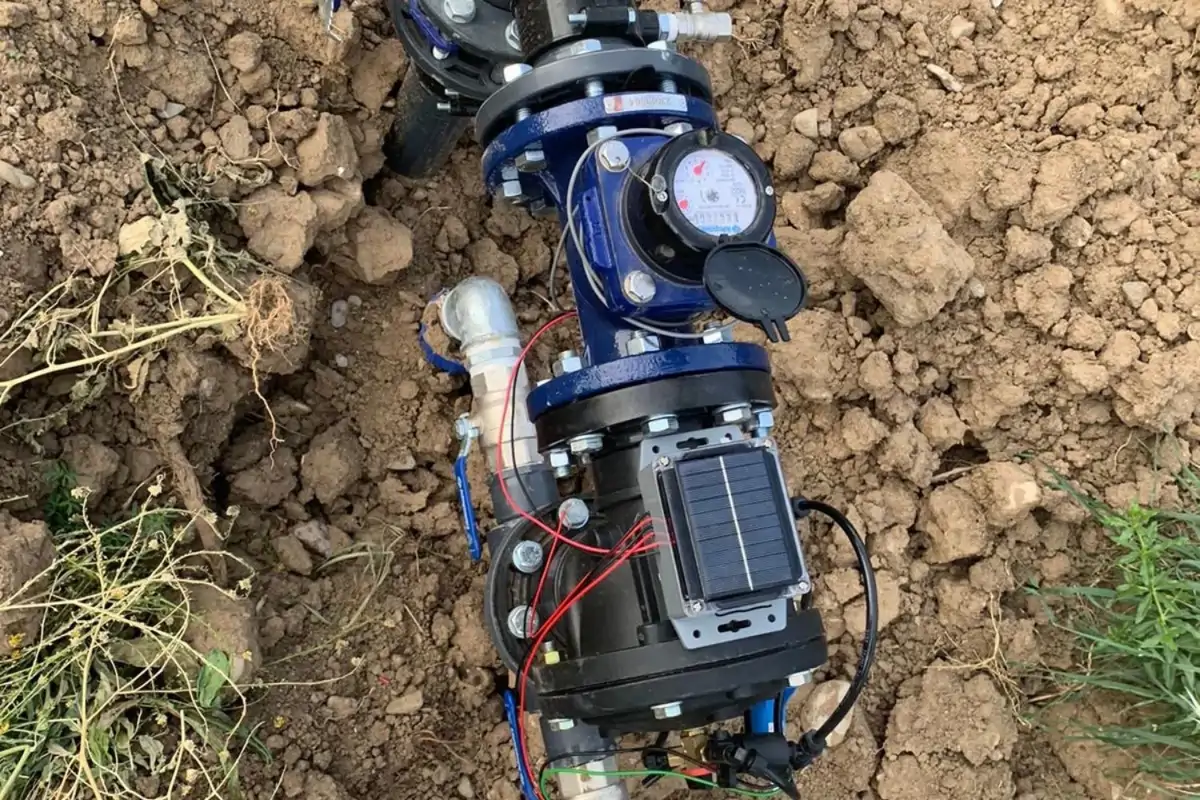
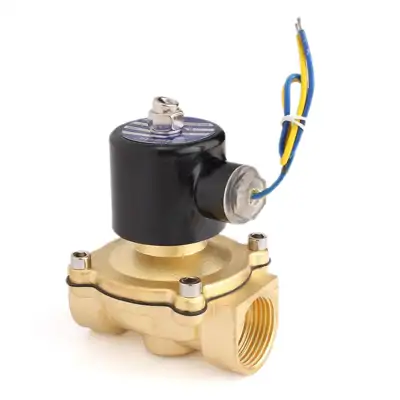
Esular uses Latch technology in many applications, including combining it with fluid control, which allows air, hydraulic, and water control valves to be used in completely new and different ways.