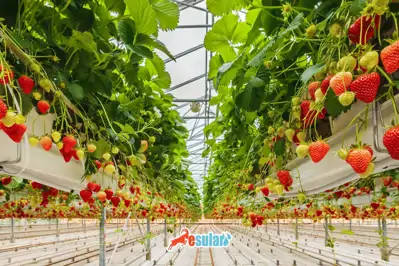
It is important to increase the temperature in winter months and to provide ventilation and cooling in summer months to accelerate the growth of plants grown in the greenhouse. The irregular distribution of heat and humidity can be balanced with ventilation. When the outside temperature is lower than the inside temperature value in winter, heat energy is continuously lost to the outside environment through the covering material. To correct this situation, it is necessary to provide heating inside the greenhouse. The need for ventilation varies depending on the plant and the production season. Ventilation systems are generally divided into two types: natural and mechanical (forced).
Mechanical Ventilation Systems in Greenhouses:
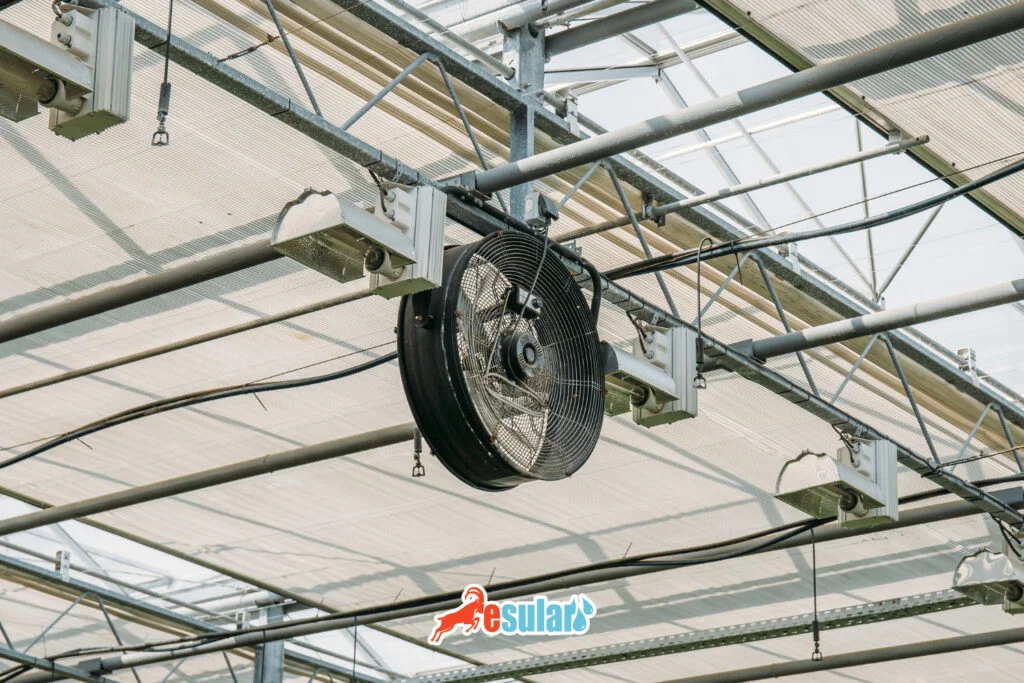
In cases where natural ventilation in greenhouses is not effective or not suitable for cultivation, forced ventilation systems can be activated. In this case, fans are generally used. With forced ventilation, the internal greenhouse temperature can be equalized to the same level as the external environment temperature. This system ensures that high humidity that may occur inside the greenhouse, especially in stagnant air conditions, is quickly exhausted.
The advantages of forced ventilation are as follows:
Since it does not provide positive air movement, the humid air around the plant is removed, increasing evapotranspiration and reducing the risk of disease.
The internal temperature of the greenhouse can be controlled more precisely.
Smaller ventilation openings are required.
The system can later be converted into an evaporative cooling system.
Labor requirement is lower.
The probability of damage to ventilation constructions in stormy weather is low.
However, there are also some drawbacks to forced ventilation:
Operating and maintenance costs are high.
Special solutions may be needed due to low ambient temperatures, especially in the winter months.
If not properly selected, fans may cause an unwanted increase in noise.
During ventilation on days with high radiation in the winter months or transition periods, cold outside air can directly enter the greenhouse.
Natural Ventilation Systems in Greenhouses:
In the summer months, the internal greenhouse temperature reaches values of 55 °C or more due to the sun heating the air inside the greenhouse. Most plants are adversely affected when the internal greenhouse environment temperature exceeds 45 °C. Stagnant greenhouse air with a natural mixture needs ventilation to increase the CO2 depleted by photosynthesis and to facilitate the flower fertilization of plants. For all these reasons, the air inside the greenhouse must be changed regularly.
Factors affecting natural ventilation include temperature differences, humidity differences, wind effect, and elevation differences between ventilation windows. In windless conditions, side wall and roof windows should be completely open. On windy days, side wall windows and roof windows on the opposite side of the wind should be open, while those in the direction of the wind should be closed.
Ventilation is basically the replacement of the air inside the greenhouse with the outside environment air. For this process to take place, there must be physical differences between the inside and outside of the greenhouse. Pressure differences caused by internal and external air temperature differences, pressure differences caused by differences in humidity, pressure differences occurring with the effect of wind, and the elevation difference between ventilation windows play a role in the formation of natural ventilation movement. For natural ventilation to occur:
Average wind speed,
Effective wind direction,
Information on daily and seasonal changes in wind speed and direction,
The presence of obstacles (such as trees, buildings, hills) in front of the wind is important.
The operation of natural ventilation windows is different in windy and windless conditions. On windless days, side wall and roof windows should be completely open. On windy days, both side wall windows and the roof window in the opposite direction of the wind should be open, while the window in the direction the wind is coming from should be closed.
For Efficient Greenhouse Ventilation:
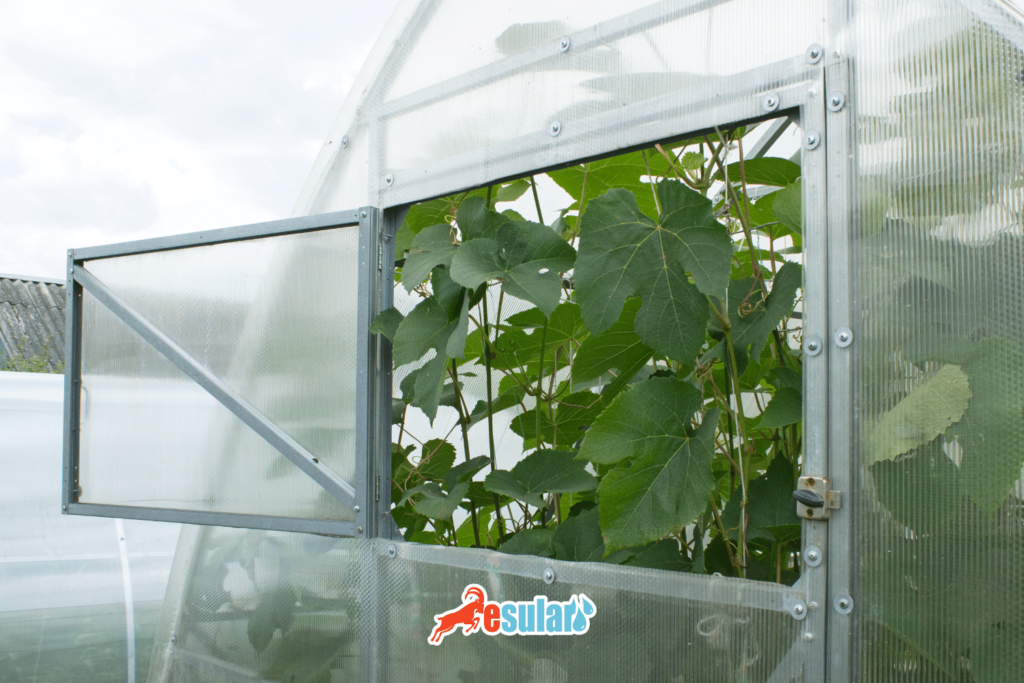
In order to provide efficient ventilation, ventilation windows are placed on both side walls of the greenhouse and on both sides of the roof ridge. The total area of the windows should be at least 15% of the greenhouse floor area, but ideally, this ratio should not exceed 30%. The area of the windows placed on the side walls should be similar to the windows on the roof. When the roof windows are fully opened, the windows should have an angle of 60° with the side surface of the roof, and 45° with the vertical side wall on the side walls. Window widths should be approximately 0.075 of the greenhouse width (W).