What Are Precipitation Types?
What are precipitation types? The first thing we should look at in the answer to this question is what are the precipitation types in terms of formation. Precipitation types in terms of formation are;
Convectional (convection) precipitation
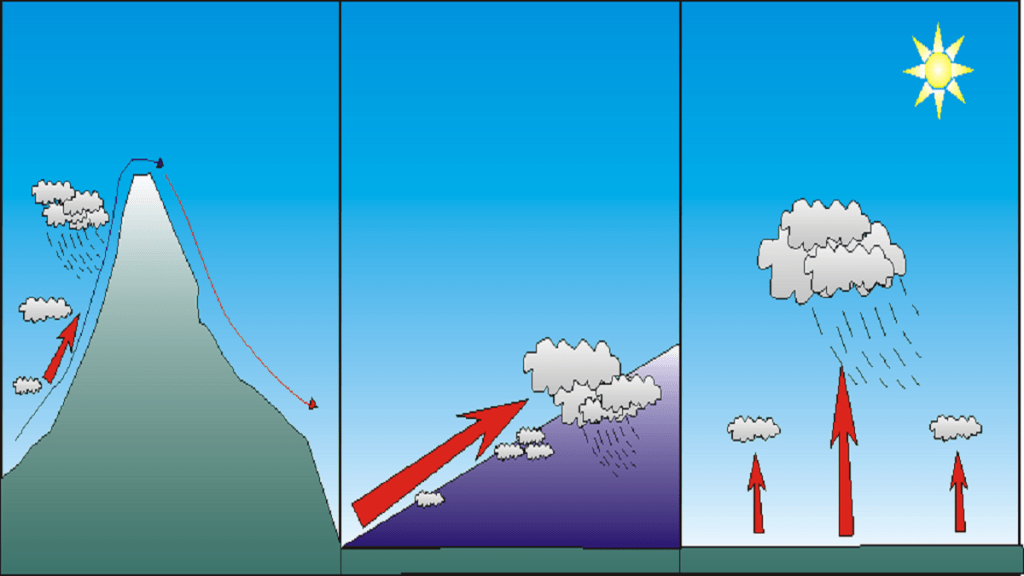
Convectional (convection) precipitation, this type of precipitation that occurs especially in the spring and months, evaporation strengthens as the soil begins to warm during the day. The warming soil also heats the air mass above it. After a while, the warming air masses begin to rise vertically along with the moisture they receive from the soil through evaporation. During the ascent, adiabatic cooling occurs and cumulonimbus is formed and rain showers appear.
In Turkey, moist and cold air coming from the northwest in the spring and early summer warms up in Central Anatolia, rises and leaves precipitation. These rains are called kirkikindi rains.
Orographic (Relief) Precipitation
Orographic (Relief) Precipitation: In regions where mountains occupy large areas, moist air masses moving towards the mountains condense by rising along the slope. It leaves heavy precipitation in such regions. After the air mass leaves precipitation up to a certain altitude, it loses its moisture and becomes a dry air mass.
For this reason, the foothills of the mountains receive more precipitation. It is the place where this type of precipitation occurs most at the foothills of the Himalayan mountains and is the center that receives the most precipitation in the world. Orographic precipitation is also effective in the Eastern Black Sea Section's receiving heavy rainfall throughout the year in Turkey.
Frontal (Cyclonic) Precipitation
Frontal (Cyclonic) Precipitation occurs in the meeting areas of air masses with different temperature and humidity characteristics. While cold and dense air remains below, warm and moist air rises. As a result of both rising and contacting cold air, the warm air condenses and leaves precipitation. This type of precipitation constitutes a significant part of the precipitation on earth. In Turkey, a large part of the annual precipitation occurs as frontal precipitation.
Precipitation in the Form of Condensation on the Ground
Precipitation in the form of condensation on the ground;
Dew: It is the condensation of water vapor in the air in the form of water droplets on cold objects on nights when the air is clear and calm. It is seen in the spring and summer months. Dew occurs with condensations above 0°C, and frost below 0°C.
Frost: It is the condensation on cooling surfaces in the form of ice crystals. For frost to occur, the air must also be clear and calm.
Rime: When a fog consisting of supercooled water droplets remains on the ground for a long time, the water droplets hit cold objects and turn into ice.
Precipitation in the Form of Condensation in the Troposphere
Precipitation in the form of condensation in the troposphere is precipitation in solid and liquid form that occurs in the lowest layer of the atmosphere in contact with the ground.
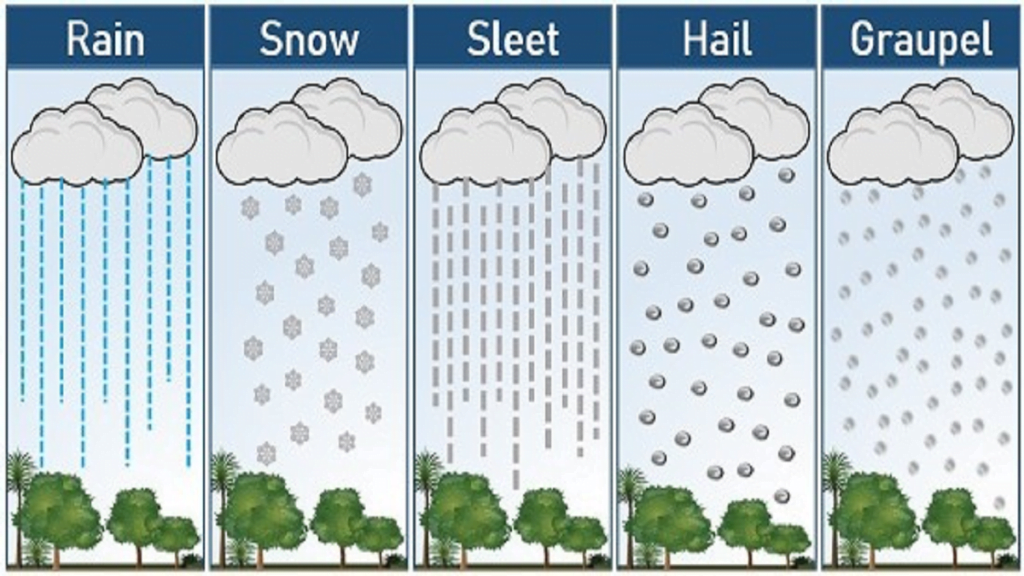
Rain: It is the merging of water droplets in the cloud in the form of drops and falling to the earth.
Snow: It is the condensation of water vapor in the air below 0°C and its transformation into fine-grained ice crystals.
Hail: In clouds where vertical air movements are very strong, water droplets freeze as the temperature drops suddenly and significantly.
You can read our article about the amount of precipitation.
What is Precipitation?
Precipitation refers to the phenomenon of water vapor in the atmosphere condensing under various conditions and falling to the earth in liquid or solid form. This meteorological phenomenon usually occurs as a result of air masses encountering a cold layer, passing through a cold region, or rising. In this process, water vapor can condense and turn into precipitation in different forms such as rain, snow, graupel, hail, or sleet.
The amount of precipitation is usually measured with measuring devices called rain gauges (pluviometers). The annual total amount of precipitation is usually expressed in units of length such as millimeters (mm), centimeters (cm), or cubic meters (m³). Daily precipitation amount is usually specified in kilograms per square meter (kg/m²).
This natural phenomenon plays an important role in the formation of climate and vegetation in geographical regions. The type and amount of precipitation can lead to important consequences in various fields by affecting ecosystems, agriculture, and water resources.
What Are the Types of Precipitation?
Precipitation is a general term referring to the condensation of water vapor in the atmosphere and its falling to the earth. This natural phenomenon can occur in different forms. Rain is in liquid form and falls to the ground as water droplets. Snow is a solid type of precipitation formed by the freezing and crystallization of water vapor in the atmosphere. Graupel is a type consisting of translucent ice grains and occurring when water droplets accumulate on snowflakes. Hail is a hard-grained type of precipitation formed by the solidification of ice crystals in the atmosphere on water droplets. Sleet, on the other hand, is microscopic water droplets that generally appear in foggy weather conditions. Each type of precipitation occurs under different conditions in the atmosphere and has important effects on the climate.