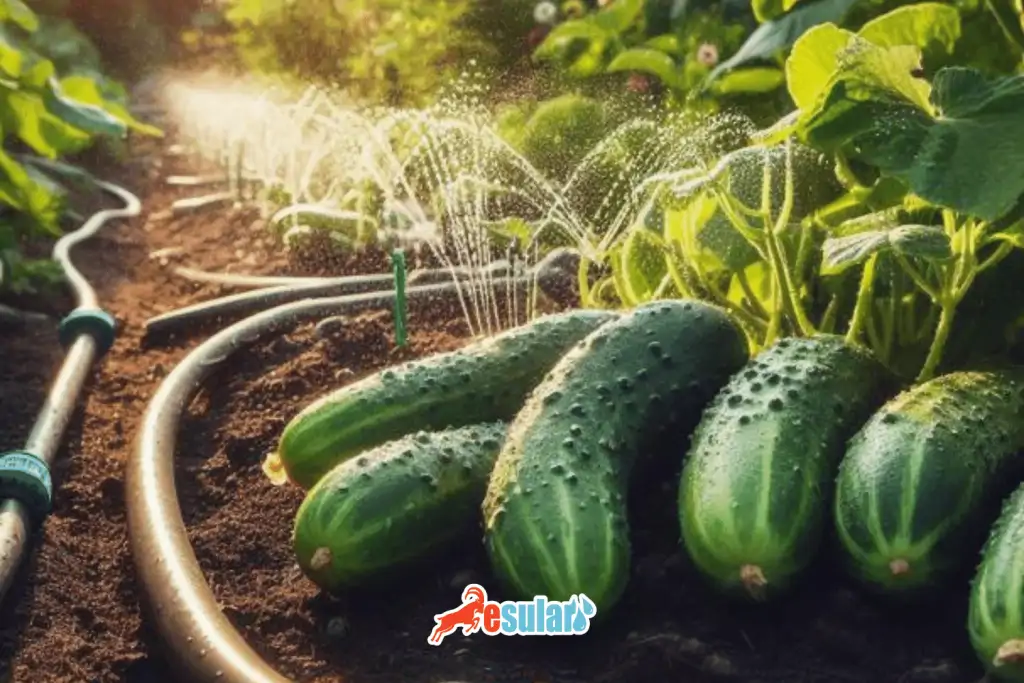
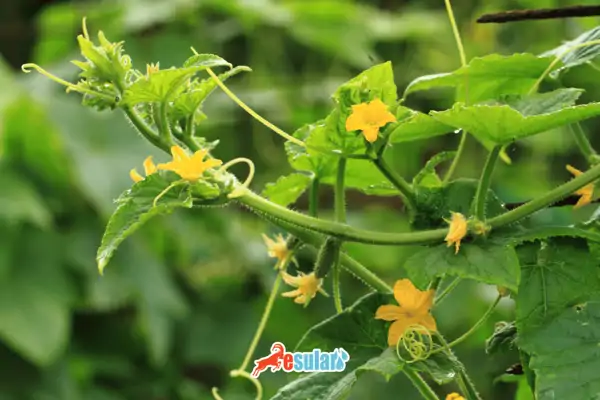
Cucumber, Cucumis sativus, is a warm-season, vining, annual plant belonging to the Cucurbitaceae family grown for its edible cucumber fruit. The cucumber plant is a spreading vine with large leaves and curling branches. The plant can have 4 or 5 main stems where the branches branch out. The leaves of the plant are arranged alternately on the vines, with 3-7 pointed lobes and are hairy. The cucumber plant produces yellow flowers with a diameter of 4 cm (1.6 inches). The shape of the cucumber fruit varies, but it is generally a curved cylinder with both ends rounded, which can reach up to 60 cm (24 inches) in length from as little as 10 cm (3.9 inches). Cucumber plants are annual plants that survive for only one growing season and the vines can reach up to 5 m (16.4 ft). Cucumber can also be called gherkin and probably originates from the foothills of the Himalayas in India.
Conditions Required for Cucumber Growth
Cucumber basic requirements require warm and dry conditions to develop best, preferring both warm days and warm nights and growing best at a temperature of 30 °C (86 °F). Cucumber gets the best yield if grown in a fertile, well-drained soil rich in organic matter with a pH between 6.5 and 7.5. Cucumber is very sensitive to cold and should be planted in full sun and provided with plenty of soil moisture due to its shallow root systems. Cucumber varieties One of the most important points to consider when choosing a cucumber variety is whether it requires pollination. Many new cucumber varieties are gynoecious, which means they produce only or mostly female flowers. Some gynoecious varieties require pollination with male flowers, in which case some of the seeds in the packet will be pollinator plants that produce male flowers. Some gynoecious varieties are parthenocarpic, meaning they do not need male plants to produce fruit. These species are recommended for growing in greenhouses as they do not require the presence of insect pollinators.
Cucumber Planting Time and Planting Method
Seed sowing Direct seeding is the preferred method as they do not transplant well in cucumber planting. Seeds should be sown after the last frosts and when the soil has warmed to at least 15.6 °C (60 °F). Sow seeds 1.3–2.5 cm (0.5–1.0 inches) deep, thin out so that there is at least 30 cm (12 inches) spacing between plants after germination. Cucumbers can also be planted on hills or mounds of soil to promote warm soil and better drainage. In this case, seeds should be sown in groups of 4–6 seeds on hills, leaving 1.2 m (4 ft) in every direction between each group. After emergence, thin the seedlings to 1 or 2 plants per hill. Cucumber seeds should germinate in 4–13 days depending on the soil temperature. General care and maintenance Cucumber vines spread and need plenty of space to grow. Vines can be trained to grow on a trellis or fence. The introduction of non-burping varieties with vertical support ensures the fruits are loose and grow straight.
Cucumber Irrigation Method
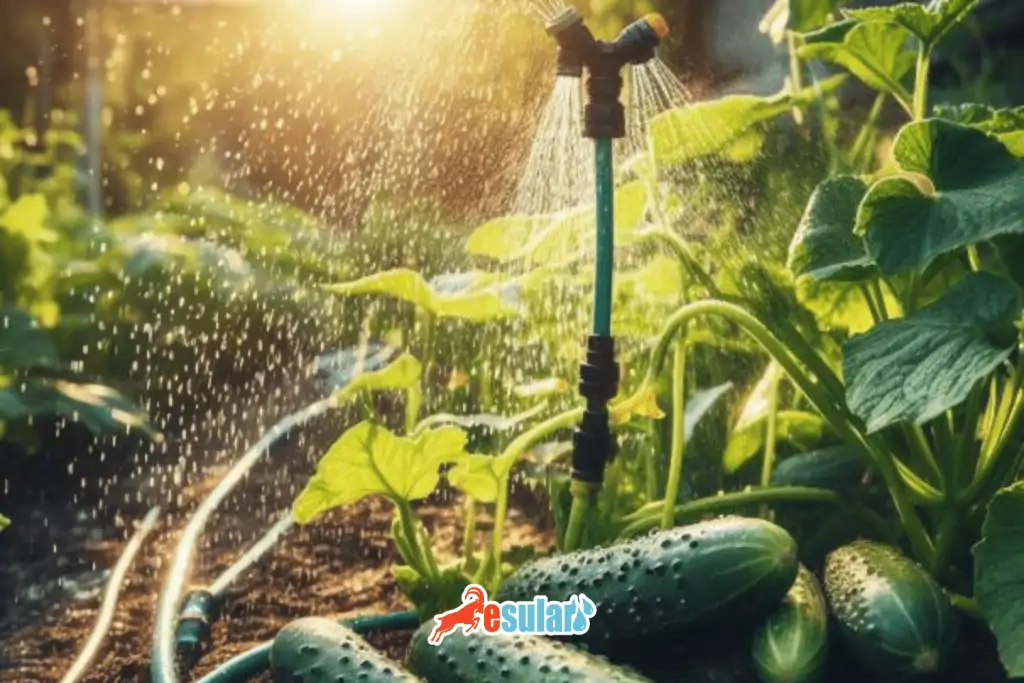
Cucumbers also need a continuous water supply and where drip irrigation is not used, plants should be watered deeply once a week, providing at least one inch of water. Shallow irrigation or less frequent irrigation will reduce fruit yield. Mulches can be used to maintain soil moisture, and black plastic mulch has the advantage of warming the soil.
Cucumber Harvest Time and Method
Harvest Cucumbers should be harvested from the plant while they are still immature and green in color. Mature fruits are yellow and the flesh is usually tough with woody seeds. The size of cucumbers at harvest depends on the variety of cucumber grown and what it will be used for. For pickling, cucumbers are usually picked when they are shorter than 5 cm (2 inches), while for slicing, non-crispy cucumbers should be allowed to reach a diameter of about 4 cm (~ 1.5 inches). It is important to remove fruits approaching maturity to ensure the plant remains productive. Their rapid growth means cucumbers may need to be harvested every few days.
Our Fields of Activity
esular smart automatic Irrigation system application areas
Where water resources are scarce, we reduce your costs with drip irrigation automation. Thanks to wirelessly controllable hydraulic valves, equal water distribution is provided to every point of the field and all are controlled from a single point
To keep greenhouse production at the desired level, improve product quality and keep pH balance under control, we make irrigation management fully automatic in modern greenhouses
In all your agricultural lands, we ensure that you use and manage the world's most valuable resource in the most efficient way without the need for cabling and external power supply. Whether you determine your irrigation scenario or perform fully automatic irrigation
In landscape irrigation, we provide more efficient and effective irrigation by making valves smart. Remotely controllable valves and remotely updated scenarios put all control in your hands
In golf and football fields, homogeneous irrigation is ensured by controlling flow and pressure values. All valves and pumps can be controlled remotely without pulling cables
Smart Cities
In smart city applications, we ensure that irrigation zones are irrigated on time and as desired with sensors that can work with wireless and 10+ year internal batteries. No more sprinklers that irrigate when it rains