Tüm Yazılar
How is Apple Cultivation Done
Apple cultivation is widely practiced throughout Turkey. However, the most suitable cultural centers are generally focused on Northern Anatolia, in harmony with the areas where wild apples spread. This region, including the transition zones between the Black Sea coasts and the Central Anatolian plateaus, and more recently the Lakes region in the South, contains important areas for apple cultivation. Isparta, Karaman, and Denizli provinces stand out among the regions where apple production is most widely carried out in our country.
When looking at global apple production statistics, it is seen to be at a level of approximately 41 million tons/year. In our country, 2.5 million tons of apples are produced annually, and with this amount, Turkey ranks third in the world. The first two places are taken by China with 17.2 million tons/year and the USA with 4.7 million tons/year, respectively.
What are the Growing Conditions for Apple
Apple cultivation is a fruit type that has stood out among other temperate climate fruits in our country for many years in terms of both production and planting area.
Climate Requirements
The apple tree is a plant generally suitable for cold temperate climates. It can grow in regions higher than 800 m in the Mediterranean Region. High light intensity is important for the color formation of the apple. Although the tree is resistant to harsh winters, it does not like high summer temperatures. In high temperatures, plant development slows down or may stop. At the same time, the apple is a fruit species that has a long-term cooling requirement. The cold requirement covers a longer period compared to other fruits. Resistance to cold decreases towards spring, and the plant is in its most sensitive state during the period when the buds swell. Immediately after the falling of the petals, when the fruits are small, the apple tree is in its most sensitive state against cold. If sufficient cooling does not occur, some of the flowers may die and the opening of the remaining flowers may be both later and irregular. Therefore, late-blooming flowers may drop due to a lack of fertilization. Also, leaf buds do not develop and the tree remains bare.
Soil Requirements
Suitable soils for apple cultivation are loamy, loamy sandy, and sandy loamy permeable, moist soils containing sufficient lime and humus. However, since iron uptake is prevented in very calcareous soils, yellowing (chlorosis) may be seen in the plant. The preferred soil depth for apple should be more than 2 meters and should be slightly acidic in character (pH=6.0-6.5). The subsoil structure of the area where the orchard will be established should allow root development, and the water in the layer where the roots will develop should be drained.
Planting Apple Saplings
When apple saplings are to be planted, care should be taken in the arrangement of the planting site, planting intervals, and layout.
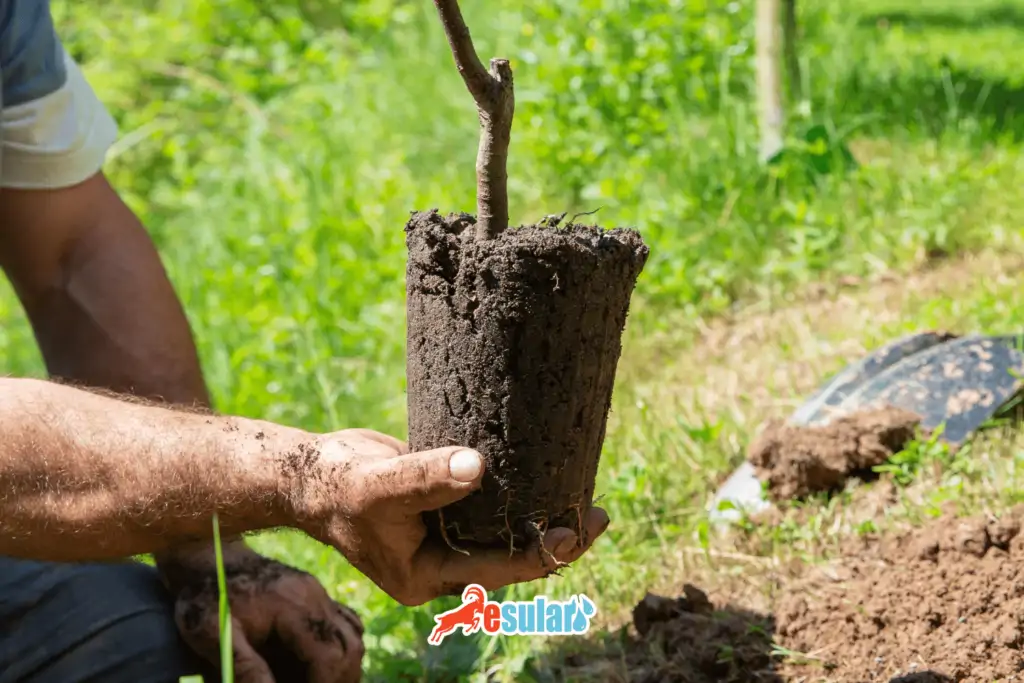
Generally, apple sapling planting is carried out in the period from leaf fall in autumn until the sap rises in the trees in spring. The most suitable period is autumn in regions where winters are mild, and spring in regions where they are harsh. When the time comes to plant the saplings, the injured and broken parts of their roots are first cleaned with the help of shears. Planting pruning ensures healthy growth by establishing the trunk-root balance of the tree. Topsoil is added to the opened pits, the sapling is placed in the middle of the planting board, and it is positioned such that the graft point faces south and is 15-20 cm above the soil level. The soil is lightly pressed so that there are no air gaps between the roots, and 20-25 liters of life water is given to the sapling.The branchless sapling planted in the spring is cut from a bud that can be a leader at a height of 65-70 cm from the graft point and 85-90 cm from the ground, after the danger of frost has completely passed. If the sapling has fewer than 3, i.e., 1-2 branches, these branches are cut and the sapling is planted by cutting it above a bud as mentioned above. The graft point should be 20 cm above the soil level.
Preparation of the Apple Orchard for Planting
To prepare the orchard site for planting, deep plowing should first be done in the field, so that aeration and sunning of the soil are ensured. One of the most important issues is soil leveling. If the terrain is sloping, it is important to perform terracing while establishing the orchard. At the same time, in regions where the groundwater table is high, drainage applications should be carried out before planting.
Soil analyses should be performed before planting saplings, and necessary adjustments should be made according to the results obtained. In general, fertilizer applications such as 3-4 tons of well-rotted farmyard manure per decare, 25-50 kg of TSP (Triple Super Phosphate) or DAP (Diammonium Phosphate) per decare, and 20-40 kg of Potassium Sulfate per decare can be recommended. However, it is most correct to perform fertilization and other applications based on soil analysis. If a drip or mini-sprinkler system is to be installed, nitrogen, phosphorus, and potassium fertilizers can be given with irrigation.
Points to Consider in Choosing Apple Saplings
When creating an apple orchard, certified saplings that are one year old and carry their name correctly should definitely be preferred. Additionally, it is important that the saplings are healthy and that their root system, diameter, and height comply with Turkish Standards Institute (TSE) standards.
Determining the Planting Sites for Apple Saplings
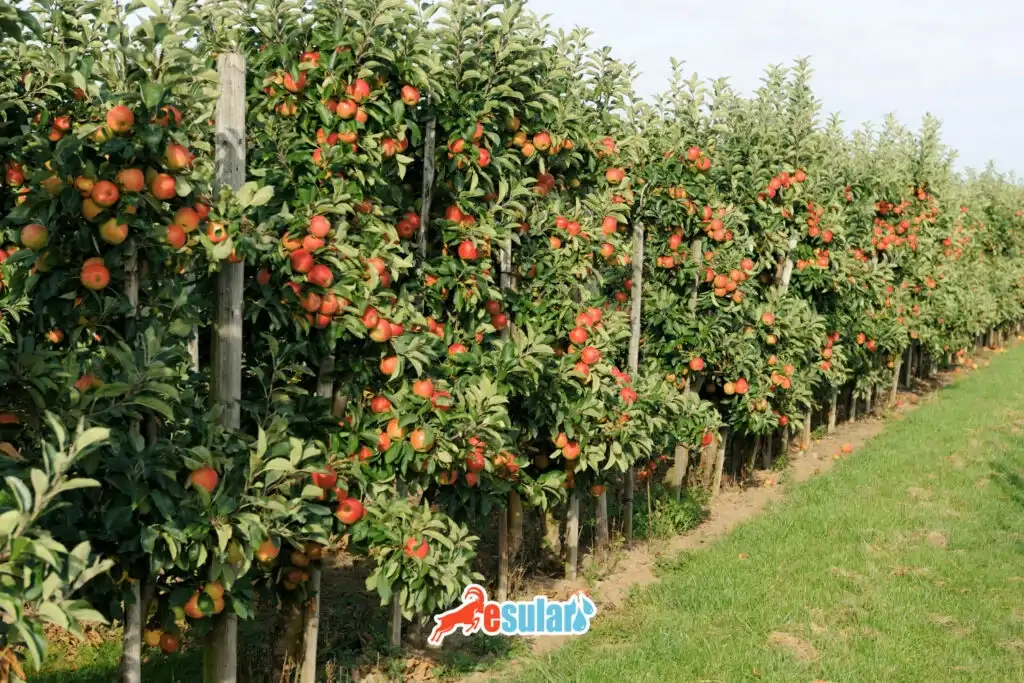
In closed-type apple orchards, triangle, square, and rectangular arrangements can be preferred. On sloping terrains, contour planting (according to elevation contours) can be applied. It is important to determine the planting points before starting to plant the saplings. The distances between trees in apple orchards vary depending on the variety, the type of rootstock used, soil conditions, and climate conditions. Furthermore, planting intervals should be wide in soils rich in nutrients and narrow in soils insufficient in terms of nutrients. While dense planting is preferred in dry regions where irrigation is required to preserve air and soil moisture, sparse planting is recommended in humid regions to increase air circulation. If the apple orchard is to be established with seed rootstock, intervals such as 5x5 m, 5x6 m and 6x7 m can be preferred. In orchards to be created with dwarf rootstocks, the interval and distance should be adjusted according to the characteristics of the dwarf rootstock to be used and the variety to be grafted.
Care in Apple Cultivation
Soil Preparation
Soil preparation is important in the apple orchard for weed control, increasing the oxygen uptake of plant roots, and the installation of irrigation systems. However, this process can damage the root and fiber system of apple trees, which have roots close to the surface. For this reason, deep plowing should not be done in a way that damages the root system, and excessively deep operations with a plow should be avoided. One should focus on processing with a disc harrow at a sufficient depth without damaging the root system.
Irrigation
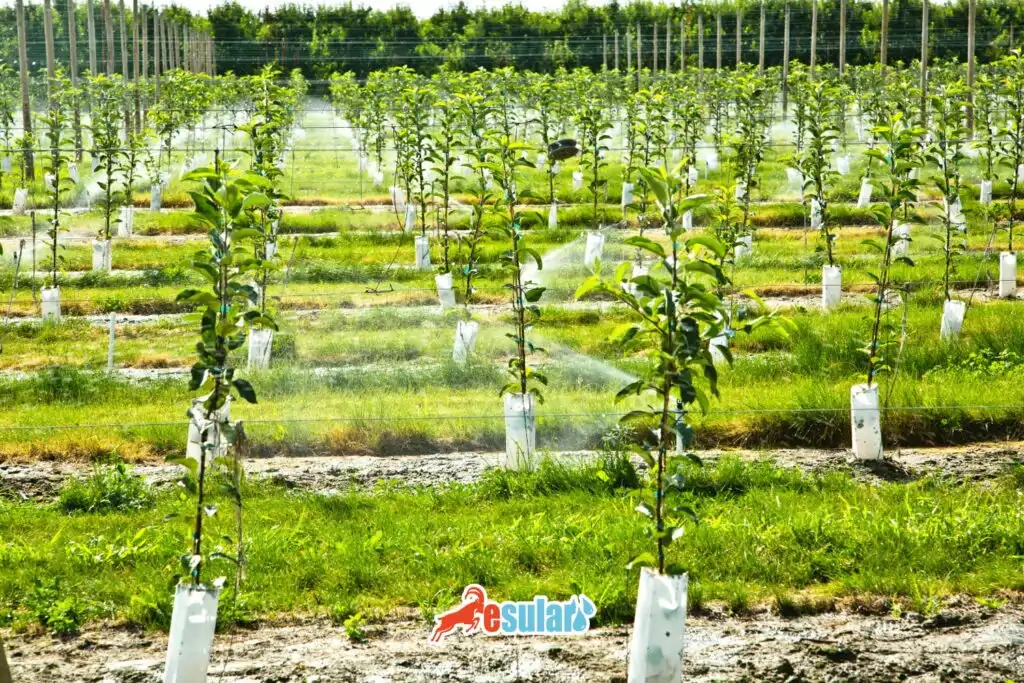
The water requirement of the orchard depends on the annual amount of precipitation, the distribution of precipitation, the intensity of water loss from the plant, the size of the tree, and the characteristics of the soil. Since apple trees have a fibrous root system, they demand more water than other fruit types and like high humidity levels. The most critical period for irrigation for apple trees is the summer months. Starting summer irrigation in May, if possible, during dry periods can increase fruit set and improve yield and quality. Correct determination of irrigation time is the key to an effective irrigation strategy. A simple manual control method can be used to check the soil moisture status. Among the most suitable irrigation methods are sprinkler and drip irrigation systems. Drip irrigation provides an effective irrigation method by ensuring that the root zones remain constantly moist.
Fertilization
In apple cultivation, to obtain high yield and quality products, in addition to other agricultural practices, it is of critical importance to carry out fertilization correctly and in a balanced manner. The amount of fertilizer to be applied to apple orchards varies depending on the soil cultivation method, soil characteristics, growth potential of the tree, its age, and the amount of product obtained. To achieve the most effective results, it is recommended to determine the amount of fertilizer using soil and leaf analyses. Before planting saplings, a basic fertilization should be done, and after planting, the orchard should be fertilized every year according to soil analysis results. Nitrogenous fertilizers can increase fruit quality, reduce fruit drop, increase yield, and reduce periodicity. However, the most important point to note is that nitrogenous fertilizers should be completely exhausted before the apples ripen. While phosphorus supports the tree's healthy flowering and fruit set processes, potassium promotes flowering, reduces periodicity, increases fruit size, flavor, and texture, and also extends storage life. It is recommended to apply between 100-250 g of ammonium sulfate or ammonium nitrate per tree before the buds burst in spring, and between 150-350 g of DAP per tree at a depth of 10 cm when entering winter in autumn.
For common fungal diseases in apples, you can look at our content below.
Kategoriler
Etiketler