How is Poppy Cultivation Done?
Poppy cultivation is an agricultural activity carried out especially to obtain poppy seeds and poppy gum. The poppy plant is generally grown in many regions of Asia and Europe. However, Turkey is also one of the prominent countries in poppy production. Poppy is grown for various purposes, ranging from the food industry to poppy gum used in medical fields. However, it is subject to international regulations due to the morphine and other opiates contained in the poppy.
Poppy cultivation in Turkey is limited by certain quotas and permits. Those who cultivate poppy must strictly comply with local laws and international regulations. This is an important step for sustainable and legal poppy cultivation. Poppy cultivation that does not comply with legal regulations may face serious sanctions.
How to Obtain a Poppy Sowing Permit?
Producers who will carry out poppy sowing must act within the time interval determined in Turkey. In this context, producers who want to obtain a poppy sowing permit must make their applications to the local Turkish Grain Board (TMO) organization between July 1st and October 30th.
In Which Provinces and Districts is Poppy Sowing Permit Granted?
Poppy sowing has been permitted in certain regions in Turkey with Decree No. 2015/7725 published in the Official Gazette. In accordance with this decision, poppy sowing and the production of unlanced poppy capsules have been permitted in the entirety of Afyonkarahisar, Amasya, Burdur, Çorum, Denizli, Isparta, Kütahya, Tokat, and Uşak provinces; the Balya, Bigadiç, Dursunbey, İvrindi, Kepsut, Savaştepe, and Sındırgı districts of Balıkesir province; the Alpu, Beylikova, Çifteler, Günyüzü, Han, Mahmudiye, Mihalıççık, Seyitgazi, and Sivrihisar districts of Eskişehir province; the Ahırlı, Akören, Akşehir, Beyşehir, Derbent, Doğanhisar, Hüyük, Ilgın, Kadınhanı, Seydişehir, Tuzlukçu, Yalıhüyük, and Yunak districts of Konya province; and the Şehzadeler, Yunusemre, Demirci, Gördes, Köprübaşı, Kula, Sarıgöl, and Selendi districts of Manisa province.
In Which Climate Does Poppy Grow?
The poppy plant is a plant species that prefers temperate climates and generally loves sun and warmth. The ideal development conditions for the plant should be provided in cool spring and temperate summer months.
In regions where the lighting duration is long or in years when the weather is clear throughout the vegetation period, the morphine rate in the plant's capsule increases.
High temperatures and low humidity during the flowering process can lead to fertilization problems and cause a decrease in seed yield. The poppy plant needs 600-700 mm of precipitation per year; it is ideal for 300-400 mm of this to be during the growing period. Rainfall occurring after flowering can cause the formation and spread of diseases.
Soil Requirements of the Poppy Plant
The poppy plant is generally a plant species that is not selective about soil and can grow in almost every type. However, sandy-loam soils are in the most suitable structure for the poppy plant. In these soil types, a homogeneous emergence can be achieved, and the plant can show healthy development by maintaining moisture. In heavy, clayey soils, root development can lead to problems and hinder germination. Since the water-holding capacity is low in sandy soils, it is difficult to maintain the moisture necessary for the healthy growth of the plant. Additionally, it should be noted that plants are more sensitive to wind and precipitation in sandy soils. For poppy to grow productively, it would be appropriate to prefer medium-weight, alluvial, and bottom soils.
Crop Rotation
Poppy is known as a plant that provides a series of advantages to agricultural practices. The fact that poppy does not exhaust the soil allows it to transition to semi-fallow, and its early departure from the field enables the subsequent sowing of other crops such as cereals. At the same time, being a hoeing plant allows the poppy to clear its own growing area of weeds and leave a clean field. It has been observed that in regions without irrigation possibilities, poppy is generally sown on fallow, followed by other plants such as cereals. These agricultural practices can encourage sustainable agriculture in terms of soil management, disease control, and productivity.
When and How is Poppy Sown?
In our country, poppy sowing is generally carried out by the hand broadcasting method, but recently, sowing practices with seeders are also increasing. In sowing done with a seeder, while the emergence is more regular, significant labor savings are achieved in agricultural operations such as hoeing and spraying. In hand broadcast sowing, after the seeds are thrown onto the soil surface, tools such as a log leveler, brush harrow, disc harrow, or rake are used to ensure the seed meets the soil. In mechanized sowing, such operations are not needed. Poppy is generally sown in the autumn months in our country; however, it can also be sown in the summer months in regions where it is damaged in winter or where winter is very harsh. Although the autumn sowing time generally shows regional differences, sowing is generally carried out in the first weeks of September. Spring sowing is done at the end of March and the beginning of April. These periods are the preferred time intervals to ensure the poppy plant grows and develops under suitable conditions.
Fertilization in Poppy Cultivation
Poppy is a plant species that loves farm manure quite a bit. Farm manure provides nutrients to plants while also having an effect that increases the water-holding capacity of the soil. Therefore, applying 2 – 2.5 tons of well-rotted farm manure per decare to the field where poppy will be sown will be sufficient both to meet the plant's needs and to improve soil quality. The most suitable time for farm manure application is the first plowing period. It is also important to provide the plant nutrients needed by the poppy to the soil with chemical fertilizers. Generally, depending on the soil structure and nutrient content, an average of 3 kg of pure phosphorus and 8-10 kg of pure nitrogen per decare will be sufficient. However, it is of great importance to take soil analysis into account when determining the fertilizer and its amount. Half of the pure nitrogen should be given before sowing, and the other half should be given in the period before the first hoeing.

Irrigation in Poppy Cultivation
Soil preparation is of great importance to achieve a successful emergence in poppy sowing. The soil must reach the appropriate moisture level before sowing or sufficient water must be given to the soil after sowing. For this purpose, in some regions, the flood irrigation method is preferred before sowing, and it is ensured that the soil is brought to the appropriate moisture (tav). Additionally, the water requirement of the poppy plant has been determined as 752 mm for winter poppy and 425 mm for spring poppy. One irrigation during the budding period for winter poppy and a total of two irrigations during the budding and flowering periods for spring poppy are sufficient. In dry spring periods, it may be necessary to irrigate the poppy plant.
When and How is Poppy Harvested?
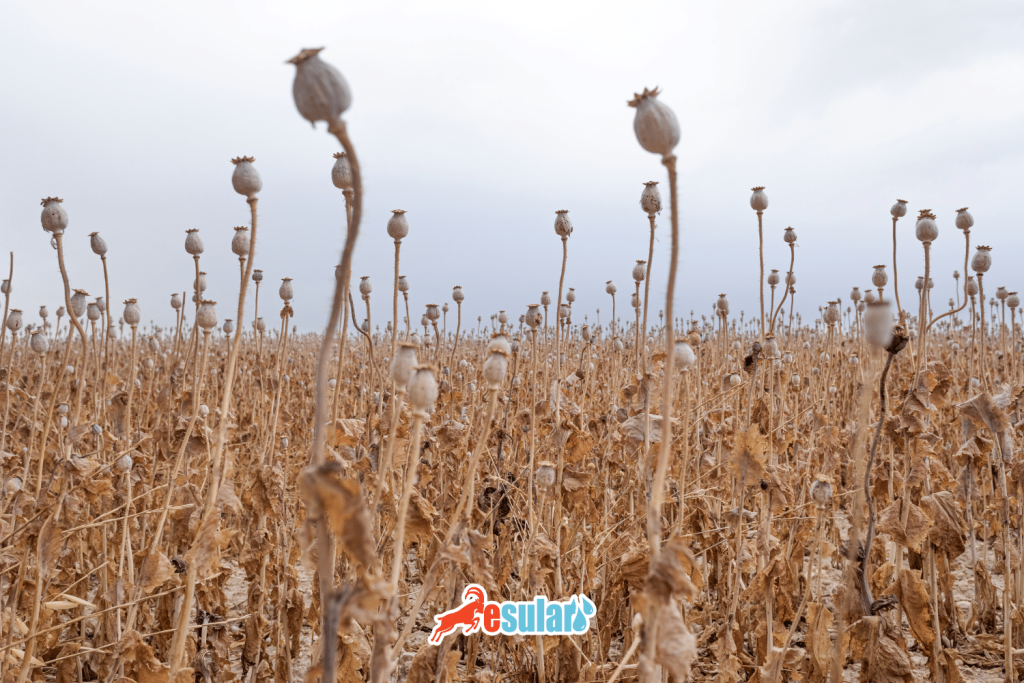
When the capsules of the poppy plant ripen, the seeds in these capsules line up on the membranes and fall to the bottom of the capsule. Ripe capsules make a distinct sound when shaken by hand. However, since all capsules in a plant or field do not ripen at the same time, it is usually necessary to focus on the lowest capsules to determine the harvest time. Whether the capsules are open or closed reflects a characteristic of the plant; however, opening can be seen even if the ripened capsules are not harvested and they dry excessively. Therefore, it is important to determine the harvest time well; otherwise, seed shedding and yield loss may occur. During harvest, capsules are collected by breaking them from their stems. The collected capsules are then passed through a capsule breaking machine or the capsule and seed are separated using wooden mallets. Care should be taken not to scratch or dust the capsules during harvest, as this may affect seed quality.
How Much Poppy is Produced from 1 Decare?
Poppy yield, the amount obtained from one decare of land, can vary depending on a series of factors. Among these factors are climate conditions, soil type and quality, fertilization methods used, irrigation schedule, disease and pest control, and sowing time. In general, between 200 and 500 kilograms of poppy can be obtained from one decare of land with appropriate agricultural practices.
Yorumlar