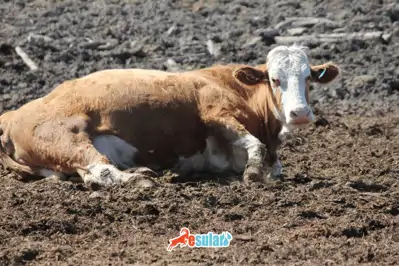
What is Angus Cattle? What are its Characteristics?
Angus cattle is primarily a cattle breed focused on meat production. Originating from Scotland, the first official registration of this breed was made in 1835; in the USA, it was registered in 1873. Currently, the Angus breed constitutes 60% of the breeds producing meat in the USA, and it is still numerically the most registered beef breed. Angus is a preferred breed in terms of carcass quality and marbling (distribution of fat) of the meat, and it is also an ideal choice for commercial crossbreeding. In commercial crossbreeding, Angus cows are specifically chosen as mothers for ease of calving. Angus is a breed that has proven itself in unassisted calving, with high efficiency, genetically hornless, resistant to harsh conditions, easily adaptable, and early maturing. It is easy to care for and is not negatively affected by harsh climates. This breed is also famous for its meat, and in recent years, its specially branded meats as "Angus Beef" are among the popular products, especially in the US meat industry. One of the typical characteristics of the Angus breed is being completely black; however, in some bloodlines, the Red Angus breed was obtained using the recessive red gene and was registered for the first time in 1954. Red Angus and Black Angus come from the same origin, but the birth weight, 205 and 365-day weights of Red Angus are close to Black Angus. The average birth weight of Angus cattle is 39 kilograms. While the 205-day live weights of male calves reach 315 kilograms, their live weights reach 545 kilograms when they reach one year of age.
Characteristics of the Angus Cattle Breed
Angus cattle are a hornless type of cattle; both bulls and cows are hornless. The head of this breed is small and the forehead part is wide. Leg bones are short, but their meat-holding capacities are high. Live weight is approximately 500 kg in females and around 800 kg in males. The meat of Angus cattle is quite delicious because the fat distribution between muscles is homogeneous; for this reason, Angus meat contains lower fat, approximately 5-7%, compared to other breeds. In comparison to the fat ratio of Angus cattle, the fat ratio of other breeds is 30%. The Angus breed is a type that can be raised at low cost and is resistant to natural conditions. Anguses, which can grow successfully despite poor pasture conditions, have the ability to protect their calves from adverse weather conditions and environmental factors after birth. Additionally, maternal instinct is high, they are calm and long-lived. Angus females mature early, and thanks to their high productivity, it is possible to obtain healthy calves even at advanced ages.
How many kilos of milk does Angus cattle give?
Angus cattle do not have milk yield. The milk of the Angus breed is produced only enough for its calf.
Is Angus meat delicious?
The superior meat quality of Angus cattle is the fundamental characteristic that allows it to constitute the majority of beef cattle breeds in the United States. Additionally, the marbling in Angus meat is excellent, which increases the quality of the meat. Due to the ideal marbling ratio, it is one of the most delicious beef meats in the world.
How many kilos does an Angus calf gain per day?
The daily live weight gain of Angus cattle varies between 1.4-1.7 kg, which shows its superiority in converting feed into meat.
Is Angus resistant to cold?
Angus cattle are generally a cold-resistant breed. These cattle can adapt to cold climate conditions and show resistance to low temperatures. These characteristics provide an advantage to farmers and breeders living in harsh weather conditions, especially in winter months. Anguses are one of the rare cattle breeds that can withstand harsh weather conditions; they can develop excellently at -30 degrees in winter and +30 degrees in summer. Along with being resistant to natural conditions, it is a type that can be raised at low cost. Anguses, which can grow successfully despite poor pasture conditions, have the ability to protect their calves from adverse weather conditions and environmental factors after birth.
Angus cattle appearance characteristics
Their colors are black and red.
Both males and females are born hornless. Additionally, this characteristic is dominantly preserved in crossbreeding with horned breeds.
Udder structure is neat.
They are long-lived.
They have high reproductive efficiency.
Their births are easy.
Maternal instinct is high.
They have a calm nature, but they can act shy towards humans.
They are resistant to harsh weather conditions.
Angus cattle yield characteristics
Significant height in males: 140 – 145 cm; in Females: 132 – 140 cm
Live weight: 1000 – 1100 kg in males; in Females: 650 – 700 kg
Calf birth weight: 39 kg
Meat yield is approximately 55% in pastures and at the 75% level in the barn.
Angus meat was registered as the "Certified Angus Beef" brand in 1978.
Advantages of Angus Cattle
The superior meat quality of Angus cattle is the fundamental characteristic that allows it to constitute the majority of beef cattle breeds in the United States. The meat of the Angus breed allows for higher quality meat production compared to other breeds. The low fat ratio of the meat is an important factor that makes Angus meat preferable. While the fat ratio in other breeds goes up to 35-36%, this ratio is around 6-7% in Angus meat. Additionally, the marbling in Angus meat is excellent, which increases the quality of the meat.
Other reasons for the preference of the Angus breed are as follows:
Being hornless: Angus cattle prevent horn injuries because males and females are hornless.
Early puberty: Angus females reach puberty at a very early age compared to other breeds, which allows for obtaining offspring in the early period.
High live weight gain: The daily live weight gain of Angus cattle varies between 1.4-1.7 kg, which shows its superiority in converting feed into meat.
Durability: Anguses are one of the rare cattle breeds that can withstand harsh weather conditions; they can develop excellently at -30 degrees in winter and +30 degrees in summer.
Ability to be used as breeding stock at an advanced age: Angus cattle have the characteristic of being able to give superior quality calves even at an advanced age, which provides a significant contribution to breeding enterprises.
Easy calving: The Angus breed has the characteristic of being able to calve easily due to its small head.