Smart Irrigation in Grape (Vineyard - Vine) Cultivation
Located in the most favorable climate zone for viticulture in the world, our country has a rich cultivation potential with a very old and deep-rooted viticulture culture. Almost every part of our country is suitable for viticulture in terms of climate. Ranking among the top five countries in the world in terms of vineyard area and production values, Turkey's viticulture is characterized primarily by seedless and seeded raisin production, and secondarily by table grape production.
If rational, scaled irrigation systems and correct cultivation methods are applied in grape production, it is a good and long-term source of income.
What is Viticulture?
Viticulture is the cultivation of wine grapes or table grapes in clusters on the vine. This involves conducting all agricultural research, cultural practices, and applying grape growing techniques until the harvest day. The plant from which grapes are obtained is called a vine. It is also called a stock or vineyard stump.
How much water does a vine need? When and how is it irrigated?
The vine needs a total of 500-1200 mm of water during the growing season. The amount and distribution of precipitation falling during the plant growth season is generally not at a level to meet the plant's water needs; in arid and semi-arid climate regions, the precipitation falling during the plant growth season remains insufficient in terms of both amount and distribution. Therefore, the missing moisture in the plant root zone is completed with irrigation water. Except for a narrow area in the Eastern Black Sea Region, all regions of Turkey are located in the arid and semi-arid climate zone; for this reason, irrigation is very important for crop production in Turkey.
Critical irrigation periods in vines;
Bud break/sprouting period: In this period, the water requirement is high so that the vineyard can start to develop.
From flowering to fruit set: This stage is the most critical period for potential water stress. Water stress can cause poor fruit set.
From fruit set to the veraison period: Water stress at this stage will cause grapes to be small, especially in table grape varieties.
Ripening period: According to research, light and frequent irrigation during the ripening stage can provide an increase in the quality characteristics of the grape.
After harvest: To provide tolerance to low temperatures in the winter season, vines need to develop sufficiently woody trunks. Therefore, it is preferred to irrigate vines after harvest to prevent leaf fall, and thus additional growth is stopped.
Drip Irrigation Method in Grape (Vineyard - Vine) Cultivation
Drip irrigation is the method in which the water required for vine development is given at short intervals and under pressure from drippers on lateral pipes by dripping onto the soil surface on the row where the vine root system is spread and located nearby (at the base of the vine).
In the drip irrigation system, water use is reduced by half compared to other irrigation methods, soil moisture can be constantly kept at the desired level, fertilization can be done along with irrigation, weed control can be achieved more easily because water is not given between rows, lands with different topographical structures can be irrigated without the need for leveling, and erosion and desertification do not occur because water is given in a controlled manner.
Advantages of Smart Irrigation Systems in Wine Grapes
Producing high-quality wine requires precise control of water and nutrients.
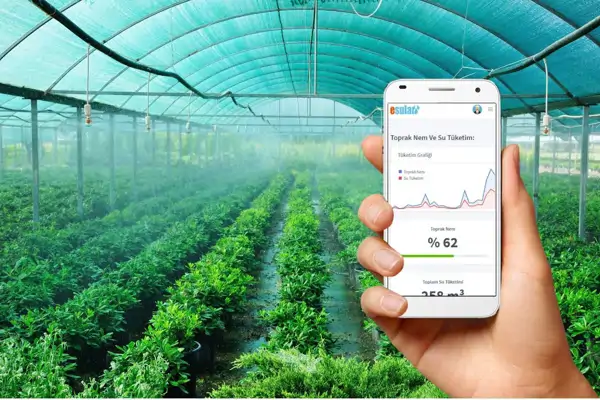
To be competitive, one should not rely solely on precipitation. Smart irrigation eliminates the dependence on rain for grape consistency every year. Meanwhile, you can improve the quality of your grapes by combining smart irrigation with drip irrigation and regulated deficit irrigation techniques. Smart irrigation provides control over quality and yield that is not possible without irrigation by providing the nutrients and water stress necessary for high-quality wine production. If you use smart control systems, your irrigation system is controlled remotely; you can keep the moisture content at the optimum level by adding many smart control sensors such as smart, ultrasonic, and phased moisture sensors, and you can provide predictive irrigation solutions based on meteorological data and precipitation status information.
Digital Agriculture in Viticulture
Especially when it comes to viticulture, thanks to digital agriculture technologies, it has simplified and changed the lives of producers in processes such as when and how to irrigate, how to apply fertilization, when and how to apply pesticides, and determining the appropriate day for harvest.
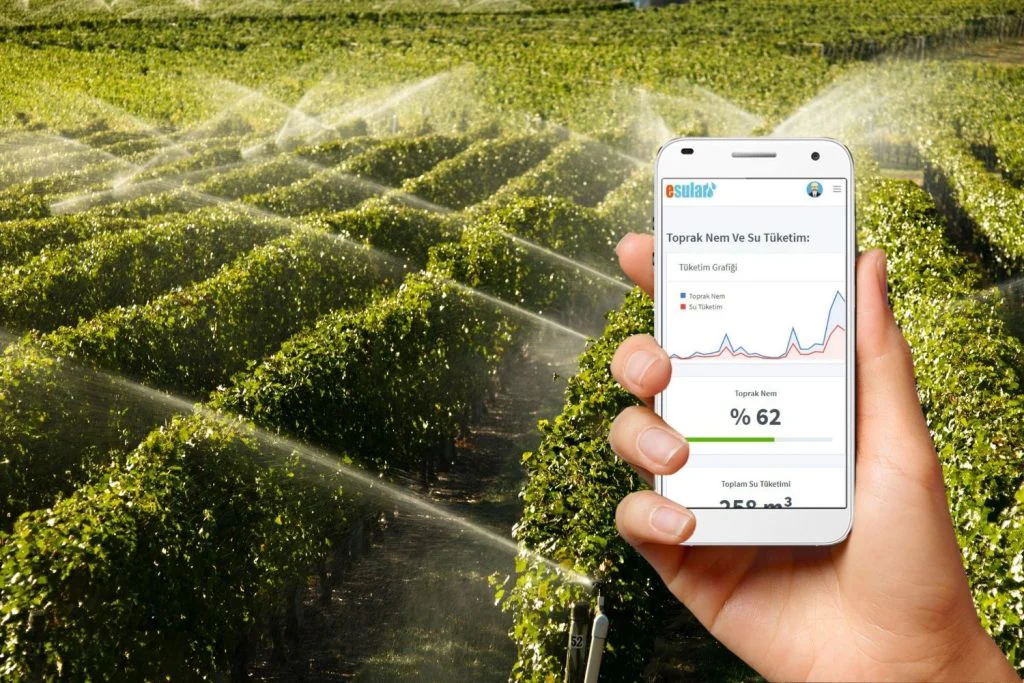
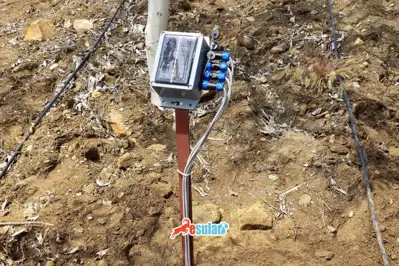
The vine producer monitors and controls their vineyards with a central irrigation control unit. With the installation of valve control and sensor units, it becomes possible to provide fully automatic irrigation with sensor options such as air humidity, soil moisture, precipitation, pressure, and flow.