What is Plant Chilling Requirement?
Plant chilling requirement is a very important phase for plants. In fruit species that shed their leaves in winter, buds must be exposed to cold for a certain period to enter winter more prepared and to emerge from winter rest. This phenomenon is called chilling. The time required for sufficient chilling is called the chilling requirement/duration. Chilling is very important to increase the resistance of plants against winter and the cold weather of winter. Thanks to this process, the plant can spend its winter sleep process and minimize the impact of negative conditions such as frost. Because the chilling phase is a sleep phase for plants. We can compare this part to the hibernation of bears. During the sleep phase, their metabolism slows down and they rest. It is particularly critical for fruit species and trees grown in temperate climate regions. Chilling occurs with the start of the winter season. The chilling hour duration is the time that trees must spend between 0°C – 7°C during the winter season. The upper temperature limit may change according to the species. For some species, it can go up to 10°C. Temperatures below 0°C are not effective for meeting the chilling requirement. Very low temperatures below 0°C do not provide benefit for the plant to complete its rest period, and may even be harmful. Temperatures between 0°C and 7°C are generally ideal for meeting the chilling requirement. Trees adapted to different ecologies have different chilling demands. For example, a species adapted to a cold winter season needs a longer chilling.

Chilling Requirement of Fruits
The chilling duration is low in vines, almonds, quinces, strawberries, figs, and some peach varieties (100-400 hours). In perennial garden plants, it is 100-2700 hours. Generally, it is between 400-1500 hours in most fruit species.
| Plant | Chilling Requirement (hours) |
|---|---|
|
Plum (American) |
700-1800 |
|
Plum (local) |
700-1750 |
|
Plum (Japanese) |
600-1600 |
|
Apple |
800-1750 |
|
Blackberry |
800-1700 |
|
Hazelnut |
850-1700 |
|
Pear |
600-1500 |
|
Currant, gooseberry |
800-1650 |
|
Walnut |
400-1550 |
|
Pecan |
650-550 |
|
Cherry (sour) |
600-1500 |
|
Cherry (sweet) |
500-1450 |
|
Blueberry |
800-1250 |
|
Peach |
375-1200 |
|
Apricot |
300-1000 |
|
Black strawberry |
350-600 |
|
Quince |
50-450 |
|
Persimmon |
50-450 |
|
Vine |
50-400 (sufficient growth) |
|
Vine |
400-1650 (faster growth) |
|
Strawberry |
50-300 |
|
Fig |
50-300 |
Soğuklama Süresini Belirleme Yöntemleri
Commonly used methods:
- Classic method (Weinberger, 1950)
- Utah method (Chill Unit) (Richardson et al., 1974)
- Dynamic method (Fishman et al., 1987)
Classic Method: In this method, an evaluation is made by calculating the total number of hours spent at temperatures below +7.2°C (45°F).
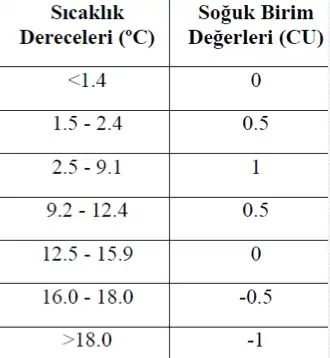
Utah Method (Chill Unit): Also known as the Richardson method. In this method, hourly temperature values are converted into "chill units". Then, the annual total of these chill units is taken to obtain the total chilling value in terms of "Chill Unit (CU)". The most effective temperatures range between 2.5 and 9.1°C, and temperatures in this range correspond to "1" chill unit.
Dynamic Method: This approach, developed by Fishman et al. (1987) and called the "dynamic model," requires a two-stage process to determine chill accumulation. Additionally, this method, similar to the Utah model, evaluates the optimum chilling temperature together with the negative effect of high temperature (Darbyshirea et al., 2011).
Research shows that the Utah model gives better results in cold regions, and the Dynamic model in temperate regions (Campoy et al., 2012; Dennis, 2003).
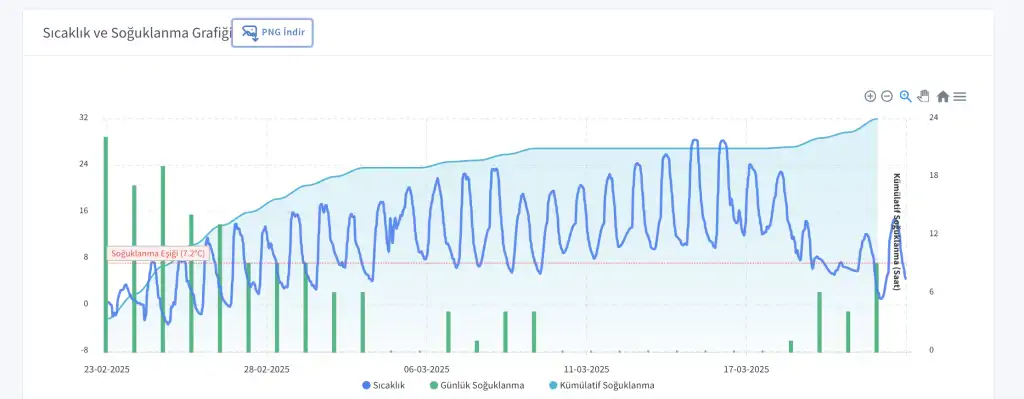
Esular Chilling Requirement Calculation
As Esular, we can precisely calculate the chilling duration of your fruit trees with our smart systems, humidity & temperature sensors, and climate station. We allow you to easily follow this process through our mobile and web applications. You can easily track how much chilling duration your fruit trees have spent throughout the season. After selecting your plant species and variety in our application, you can examine the chilling data in the date range you specify with detailed graphics. Supported by detailed weather information, our application allows you to plan ahead for potential risks. For example, you can take measures to protect your garden against approaching cold waves. By tracking the chilling process moment by moment with the Esular application, you can intervene quickly in case of deviations from ideal chilling conditions. In this way, you ensure that your fruit trees spend their winter rest process in the best way, helping them prepare for both winter and spring. Correct chilling prevents irregularities in fruit buds while significantly increasing fruit quality and yield. At the same time, it ensures you have a healthier garden by strengthening the natural defense mechanisms of plants against diseases and pests.


What are the Chilling Methods?
Chilling is carried out with various methods. These are: flooding, ventilation, and radiant heating methods are available. As in every job and process, chilling methods have advantages and disadvantages according to the fruit type and the climate conditions grown. In summary, the plant chilling process prepares plants for the winter process and protects them against weather with frost risk. Thus, the opportunity arises to obtain fruit yield and quality products.
- Flooding (Water Thinning): This method is done by spraying water around the trees or by irrigation. Heat is released to the environment with the evaporation of water. Thus, trees are protected against frost risk. However, this method may be difficult to apply in regions with high frost risk.
- Ventilation: The logic of this method is to provide air circulation. For this purpose, machines such as fans can be used. Especially today, it can be effective in regions where temperature changes are very fast and sudden.
- Radiant Heating: In this method, the garden is heated. Radiant heaters are used for this heating process. Thus, it is effective in regions exposed to low temperatures and with high frost risk.
How is Chilling Done?
The chilling process consists of several steps. The first of these steps begins with the preparation of the plant.
- Preparation of the plant: The beginning of the chilling process starts in the autumn period. In this process, the plant is first pruned and prepared for the chilling period by fertilizing.
- Following Weather Forecasts: The most critical data for chilling is the weather data. Especially to protect plants against frost risk, the weather should be constantly followed. The chilling process should be done accordingly.
- Selection of Chilling Method: A chilling method suitable for every plant, land, and region type should be selected. Whichever is suitable among flooding, ventilation, and radiant heating, that method is applied.
- Monitoring and Maintenance: The garden should be closely monitored throughout the chilling process. Especially today, we experience it very often, even our transition to certain seasonal periods does not mean that the weather conditions will be parallel to what we expect in that seasonal period. Weather changes are now very sudden and frequent. Monitoring is important to protect plants and take additional measures.
- Rest Period: In the chilling process, plants now enter the rest process and their metabolism slows down. Thus, their risk of being affected by adverse weather conditions is minimized.
Advantages of Chilling
- Ensures Transition to Rest Period: It ensures that plants enter the rest process, which is one of the most important steps of their growth. The metabolism of plants slows down, their energy consumption decreases, and the plant both protects itself against adverse environmental conditions and continues its healthy development.
- Protected Against Frost: The plant is protected against sudden, unexpected, night and day frost risks.
- Supports Flowering and Fruit Formation: Chilling increases fertility and fruits grow healthily. In this way, fruit qualities and yield increase.
- Increasing Fruit Quality: Fruit quality increases in plants that have met their chilling requirement.
- Becomes More Resistant to Diseases and Pests: The resistance of plants against diseases and pests increases during the rest process.
- High Yield: The fertility of a plant that has met its chilling requirement increases, fruit quality increases, and it becomes more resistant to diseases and pests. Therefore, yield increases.
- Correct Flowering Time: Plants wake up and flower at the right time. This ensures that their development processes are minimally affected by seasonal conditions.
- Fast Adaptation to Climate Changes: The plant is protected against sudden and unexpected weather conditions caused by climate changes.
Disadvantages of Chilling
Chilling is very important for the healthy development and yield of plants. Things we can mention as disadvantages are mostly cost-oriented situations. There will be an additional cost according to the method chosen in chilling processes. There will be personnel, i.e., labor cost, to apply this method to the land. Time needs to be allocated for this process, there will be a time cost. The part more important than all of these is to choose the correct method and apply it correctly. Because while doing a process for the benefit of the plant, we do not want to take it to a point that will be to its detriment. For this reason, the appropriate method should be selected with great sensitivity and applied appropriately. For example, in the flooding method, flooding too much water can cause fungal diseases in the plant, and if radiant heating is not done correctly, it can lead to results such as overheating or burning.
Frequently Asked Questions
What is Chilling?
Chilling is the requirement for plants, especially in fruit species that shed their leaves in winter, to be exposed to cold for a certain period to enter and exit winter more prepared and to protect themselves against adverse weather conditions. This phenomenon is called chilling. In this way, trees enter the rest process, their metabolism slows down, and their growth continues healthily.
What is Chilling Requirement?
The time required for sufficient chilling is called the chilling requirement/duration.
Why is Chilling Important?
In a tree that has not met its chilling requirement, fertility and fruit quality decrease, its resistance to diseases becomes low, and it becomes vulnerable to frost risk. Ultimately, its yield decreases.
What are the Chilling Methods?
Chilling methods: The most commonly used methods are flooding, radiant heating, and ventilation. The chosen method must be suitable for the tree and location and must be applied correctly.
When is Chilling Done?
Chilling mostly begins in the autumn period. In this period, trees begin to enter the rest period, air temperatures drop, and frost risk increases.
Things to Consider While Chilling
The most critical point is weather data. It is necessary to follow this data constantly. According to this data, for example, extra measures should be taken on days and nights with frost risk, but the measures taken should not be excessive.
Which Trees is Chilling For?
Chilling is important in fruit trees that shed their leaves in winter and in regions with high frost risk. Climate conditions help in determining whether it is necessary or not.
What Happens if Chilling is Not Done?
When the chilling process is not done, the plant remains most vulnerable to risks such as frost. Abnormal flower buds form. When the chilling requirement is not met, flower bud drop (bud shedding) occurs frequently. Fertility and fruit quality are negatively affected. Resistance to diseases and pests becomes low. At the end of the day, yield decreases.
What are the Contributions of Chilling to Plant Health?
With chilling, the plant enters a healthy sleep, i.e., rest phase. It slows down its metabolism, thus minimizing the energy it consumes. It protects itself from risks such as frost. In this way, healthy fruit development continues. Fruit quality and yield increase. It becomes more resistant to diseases and pests.